
Key Takeaways
Cash is the most common, permissible Islamic wedding gift, given in a card at the walima.
Amounts vary by community. US friends often give from around $50; close relatives give more.
The best non-cash gifts last and are shared: keepsakes the couple uses together daily.
Giving builds love: “Give gifts and you will love one another”¹².
Choosing a wedding gift for a Muslim couple can feel quietly high-stakes. You want it to be welcome, appropriate, and remembered, not just another box on a side table. The good news? The path is simpler than most guides make it. This page walks you through what to give, the gentle etiquette behind it, and the one thing nobody else maps for you: how much cash to actually put in the card.
We’ve organized everything around what couples genuinely value. Cash for the new household. Lasting keepsakes they’ll share. And a clear, copy-from sense of amounts, so you can give with confidence instead of guesswork.
What Do You Give as a Gift at a Muslim Wedding?
Cash is the most common and religiously permissible gift at a Muslim wedding, usually given in a card or decorative box at the evening reception, or walima. Beyond cash, the most meaningful gift is a lasting keepsake the couple can use together, something that outlives the day and quietly marks the start of their shared life.
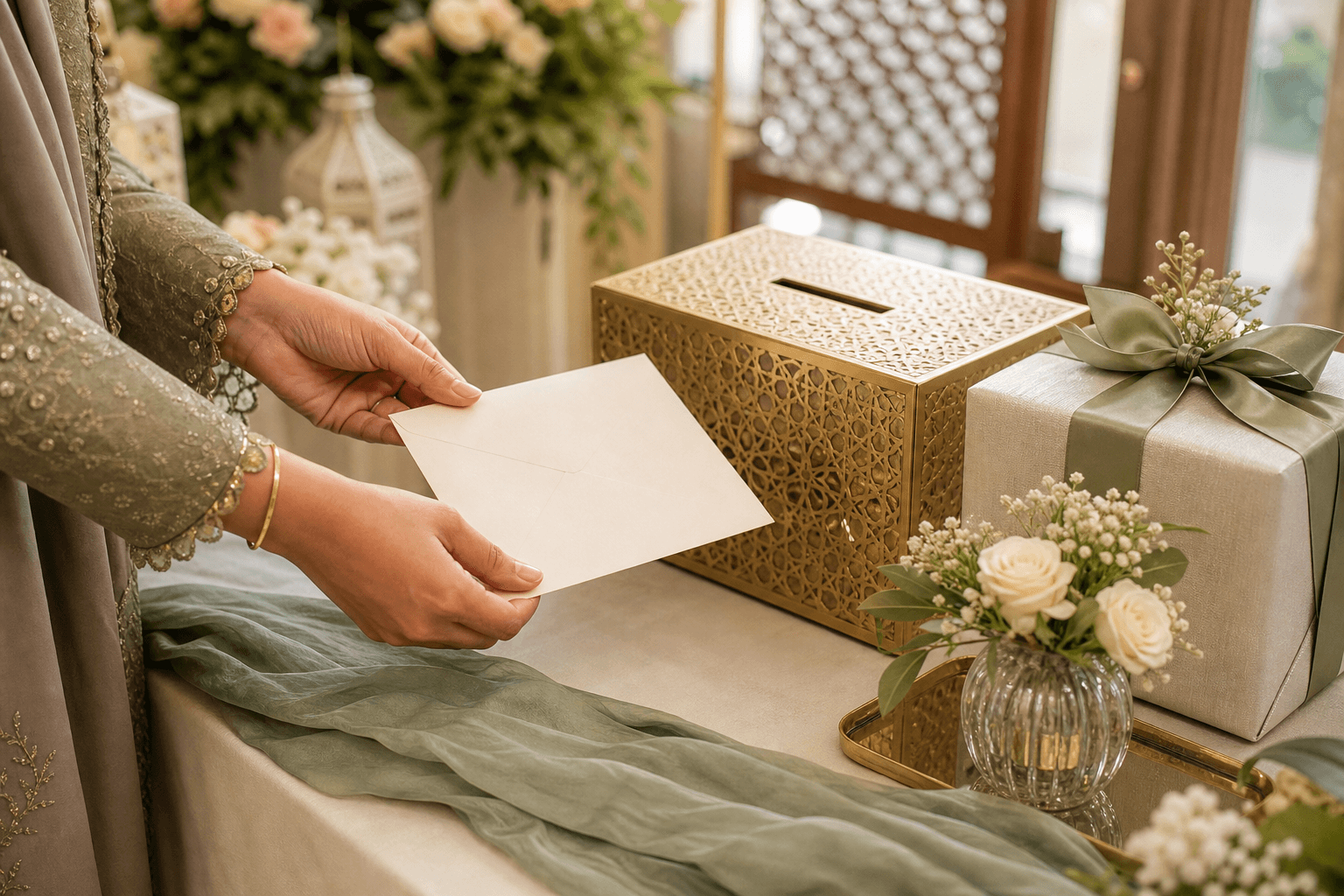
A guest’s wedding gift is a hadiya: a gift given freely, out of love, with nothing expected back. That spirit is rooted in the Prophetic tradition. In a narration recorded in Imam al-Bukhari’s Al-Adab al-Mufrad (hadith 594, narrated by Abu Hurayra and graded hasan by al-Albani), the Prophet Muhammad said, “Give gifts and you will love one another.” Gifting, in other words, isn’t a social tax. It’s a way to grow affection between people, which is exactly what a wedding celebrates.
One thing is worth clearing up early. A guest’s gift is not the mahr. The mahr is the obligatory bridal gift the groom gives directly to the bride as a condition of a valid nikah, and it belongs entirely to her³. Guests never contribute toward it. So when you give, you’re giving a hadiya to the couple, separate from the marriage contract itself.
Who gives, and when? Guests typically bring their gift to the walima, the celebratory meal hosted after the marriage is contracted. Cash is usually presented in a card or placed in a designated box near the entrance or the couple’s table. Close family may give earlier or privately; friends and extended relatives generally give at the reception. There’s no single correct moment, so follow the rhythm of the event you’re attending.
Most gift guides skip a thoughtful scholarly nuance here. Is the cash a free gift, or something closer to a loan you’ll get back at your own future wedding? Scholars hold more than one view. We cover both in the cash section below, because the honest answer depends on your community’s custom. For now, hold the simple version: among Muslim families, giving generously at a wedding is welcomed, encouraged, and good.
We keep the finer points of permissibility, such as why certain gifts are best avoided, for the etiquette section further down, so nothing gets repeated. And if you’re shopping for the wider category beyond weddings, See all islamic gifts.
Prefer to give something lasting rather than cash? You’re not alone, and you’re not making a lesser choice. Many guests pair a modest amount in the card with one shared keepsake the couple will reach for long after the day fades. We map those keepsake ideas, and what makes one truly fitting, in the categories section.
How Much Cash Should You Give at an Islamic Wedding?
There’s no fixed amount. Muslim communities and families differ widely, so give relative to your closeness to the couple and your local custom. As a US starting point, friends often give from around $50, and close relatives give considerably more. Treat any figure here as a floor to build on, not a fixed rule.
Because Muslim-specific cash data is rarely published, the most useful public benchmark is general US wedding etiquette, which most Muslim families in the US loosely track. In 2024, the average wedding guest spent $150 on a gift, unchanged from 2023, according to The Knot’s guest study⁵⁶. That’s a helpful anchor. But remember it blends all relationships and regions, so your own number should flex up or down from there.
Below is the by-closeness map, ready to copy. Bear in mind that every figure swings widely depending on your community and family, so each one is a starting point and nothing more.
Your relationship to the couple | Typical US range | Note |
|---|---|---|
Friend, neighbor, or colleague | $50 to $150 | Coworkers often sit at the lower end ($50 to $100); casual friends a little higher. Varies by community and family. |
Aunt, uncle, or cousin (extended family) | $100 to $200 | Scales with how close you are and how your family typically gives. Varies by community and family. |
Close or immediate relative | $150 to $300+ | Siblings, very close family, and wealthier communities often go higher. Varies by community and family. |
These bands draw on The Knot’s guest study and are echoed by other US etiquette guides; Brides.com, for instance, puts friends around $75 to $100 and close family or the wedding party around $100 to $150 or more, with wealthier circles often giving higher. They’re US etiquette norms, not Muslim-specific rules, so read them as orientation rather than instruction.
Why do closer guests tend to give more? Part of it is the informal “cover your plate” idea: guests aim to roughly offset what the couple spent hosting them. For context, the average cost per wedding guest in the US is about $292, per The Knot’s 2026 Real Weddings Study (based on couples married in 2025). That’s general US context, not a Muslim-specific figure, and not a target you owe. It simply explains the upward pull on amounts at lavish receptions.
How is the cash actually given? Almost always inside a card, or placed in a designated decorative money box set out at the reception. Cash, a check, or a gift card all work; a short handwritten du’a or blessing on the card means more than the amount. Among Muslim families, that small note of prayer is often the part the couple keeps.
Now, the scholarly nuance we promised. There are genuinely two scholarly framings of wedding cash, and it would be dishonest to flatten them into one.
View A: the money is a hadiya, a voluntary gift given freely out of love, with nothing owed in return.
View B: the dominant position recorded by IslamQA treats wedding money (nuqoot) as a customary loan that should be reciprocated on the giver’s own future occasions, precisely because local custom usually expects that reciprocity⁴.
The two views reconcile through custom. IslamQA’s own exception notes that “if the custom in a particular country is that what is given on such occasions is purely a gift, then it is not a debt.” So whether your gift is a free hadiya or a reciprocal loan depends on what your community actually practices. We’re not issuing a ruling here; if this matters for your situation, ask a qualified scholar, and see gifts islam for the deeper treatment.
What Gift Is Truly Appropriate in Islam? 6 Meaningful Nikah & Walima Gift Categories
In Islam, a truly appropriate wedding gift falls into one of six categories: cash, an everyday faith item, a shared keepsake the couple uses together, a personalized custom piece, a charitable gift in the couple’s name (sadaqah), or a meaningful experience. Name the six, and almost any good gift fits one. The test: will this couple genuinely use or be blessed by it?
We built this rubric as a simple way to judge fit, not as a fatwa. Think of each category as having one quick test and a clear “who it suits.” Here is how they break down.
1. Cash, the most flexible gift
Cash never misses, and it’s always welcome. That holds especially for a couple setting up a new household, because it asks nothing of your taste and everything of your generosity. The test is simple: when in doubt, reach for it. As covered above, many friends start from around $50 and scale up with closeness. If you want a single safe choice, this is the one.
2. An everyday faith item they will actually use
This category passes one test: will they reach for it daily? A beautiful, wearable piece of faith jewelry, a Smart Dhikr Jewelry companion, earns its place in someone’s everyday life rather than a drawer. WESLAMIC’s iTasbih Faith series is built exactly for this: faith you can simply put on and carry through the day, letting each dhikr happen a little more easily. It suits a partner just beginning to weave devotion into ordinary life, gently, never as a duty.
3. A shared keepsake the couple uses together
The most resonant wedding gifts are shared. This category is best when both spouses use the gift together, so it becomes part of their story, not just one person’s. The iTasbih Relation series was made for this idea: a single piece carried between two people, quietly holding the bond they keep close. It’s a natural fit for weddings and any moment that celebrates connection, which is the heart of a marriage.
4. A personalized, custom piece for this couple
Choose this when you want the gift to mark this particular couple, no one else. Personalization, an engraved name, a wedding date, a chosen word, turns an object into a memory. For a milestone like marriage, a premium personalized piece carries real weight. WESLAMIC’s high-end women’s line treats devotion as fine jewelry, beautiful enough to wear daily and unmistakably hers, which makes it a thoughtful centerpiece gift for the bride or a signature self-purchase. Pieces like this also sit naturally alongside our wider range of islamic gifts for women.
5. A charitable gift given in the couple’s name (sadaqah)
Give this when you want reward to flow in the couple’s name rather than an object into their home. A one-off donation made in the couple’s name is sadaqah, a charity that blesses both giver and couple. It becomes sadaqah jariyah, continuing charity, specifically when the gift keeps generating benefit over time, for example a contribution toward an ongoing cause or a lasting, endowment-style provision in their name. We’re describing a thoughtful framework here, not a fatwa; for the finer rulings on charitable gifting, see gifts islam.
6. A meaningful shared experience
Some couples value memory over objects. This category suits them: an experience they share, a honeymoon contribution, a special meal, a course they take together. It leaves no clutter and plenty of story. If the couple already has a full home, an experience is often the most generous thing you can offer.
A quick word on what to gently avoid, since “appropriate in Islam” cuts both ways. Steer clear of anything tied to alcohol, non-halal items, or figurative or anthropomorphic religious imagery; these miss the mark regardless of how lovely the packaging is. When unsure, the six categories above keep you on safe, welcome ground.
Islamic Wedding Gifts for the Couple (Things They’ll Share)
The best wedding gifts for a couple are the ones they use together. Not the ones that pick a side. A shared keepsake folds quietly into both their days, which is why it tends to outlast a gift addressed to just one of them. Think of it as a gift to their marriage rather than to either spouse alone.

What makes a gift truly shared? It earns a place in their ordinary routine and belongs to the two of them equally. Think of a keepsake both reach for, something that marks their bond, a set they open together at the walima. Each quietly says you are a pair now, the emotional note a wedding is built on. The gift that echoes it is the one they remember.
This is the exact feeling behind the iTasbih Relation series: one shared piece that passes between two people and keeps their connection close as the day moves along. It’s the natural answer when you want a single gift to honor both of them at once, a small daily reminder of the bond their wedding celebrates. We expand on the everyday-wear case for keepsakes like this near the end of the page.
Want to hand over something that already feels like an occasion? WESLAMIC’s iTasbih ceremonial gift set is wrapped to feel like an event and made to be remembered: a ritual in a box the couple can open side by side. Pair it with a short du’a on the card, and the shared gift and the shared blessing arrive together.
Islamic Wedding Gifts for the Bride, Groom & Parents
When a gift is meant for one person, match it to who they are: beauty with meaning for the bride, something he will genuinely carry for the groom, and a quietly honoring keepsake for the parents who raised them. Match the gift to the person and it lands; here is how each one breaks down, so you can choose quickly.
For the bride
For a gift that’s hers alone, lean toward beauty with meaning. WESLAMIC’s high-end women’s line is faith rendered as fine jewelry, refined enough to wear with anything and made to feel entirely like her own, which suits a milestone gift for the woman who values beauty and devotion in equal measure. It also sits comfortably within our broader islamic gifts for women range if you want to compare options first.
For the groom
For the groom, the everyday-faith test works well: choose something he will actually carry. The iTasbih Faith series slips into a daily routine, an unobtrusive piece that makes reaching for dhikr feel effortless, a quiet, meaningful gift for someone weaving devotion into ordinary life. For a softer, peace-centered alternative, the iTasbih Salam series turns a moment of remembrance into a small return to calm, a reassuring gift as he steps into a new chapter.
For the parents and in-laws
Parents are easy to forget, yet a small gift to them is one of the warmest gestures you can make at a wedding. Two ideas fit beautifully. The first is a tasteful keepsake they can keep on display or carry, something that honors their role without asking anything of them. The second is a charitable gift, a sadaqah given in the parents’ name, where the reward flows to them as their child begins married life. Both say thank you for raising someone worth celebrating, which is often exactly what the moment calls for. For the finer points on charitable gifting, see gifts islam.
Whoever you’re buying for, the formula stays simple. Pick the gift that fits the person, add a modest amount in a card if you like, and write a sincere du’a. That combination, a lasting keepsake plus a heartfelt prayer, is what people remember long after the flowers are gone. Looking for inspiration beyond weddings? Browse our islam present ideas for more.
Personalized & Unique Islamic Wedding Gifts (Beyond Plaques & Hampers)
The gifts people remember are the ones made for this couple, not the default plaque or hamper everyone else brings. Generic gifts are kind. But they rarely get a second glance once the day is over. A personalized or genuinely unique piece earns a lasting place precisely because it could only have been given to them.
It helps to name the tired defaults so you can move past them. A mass-produced calligraphy plaque, a wrapped hamper of sweets, a boxed set of mugs, each is pleasant and each is forgettable, because dozens of guests arrive with something close to it. The couple ends up with a shelf of near-duplicates and no single gift that feels like theirs. That’s the gap a personalized gift closes.
What stands apart is a piece that carries their name, their date, or a word that means something only to them. A small custom touch like that turns an ordinary object into something they keep, because it could only ever have been theirs. For a milestone like marriage, that is what separates a gift that gets used from one that gets stored.
WESLAMIC’s high-end women’s line can be personalized into fine jewelry that carries her name or date, the kind of one-of-a-kind piece that says this was chosen for you. Want to hand over something that already feels ceremonial? The iTasbih ceremonial gift set arrives boxed like an occasion in its own right, ready to be kept long after the day. Either way, you’re giving past the plaque, toward something the couple will actually treasure.
Islamic Wedding Gift Etiquette: What to Avoid & How to Congratulate the Couple
Good wedding etiquette in Islam is mostly about thoughtfulness, not strict rules. Give a hadiya freely, present it gracefully at the walima, avoid the few things that genuinely clash with Islamic values, and offer the couple a warm word of blessing. Get those right and you’re giving well. The Prophetic encouragement to give gifts so affection grows¹² is really the whole spirit in one line.
A few gentle guidelines make the difference.
Give what you can, freely. A hadiya is voluntary. Don’t stretch beyond your means to match someone else’s number; a sincere, smaller gift given warmly is better than a large one given grudgingly. The intention behind the gift matters as much as its size.
Steer clear of the clear no-gos. Skip alcohol and non-halal food. Skip any figurative or anthropomorphic religious imagery too. These are the main things that turn a well-meant gift into an awkward one, and a faith-centered or genuinely useful gift sidesteps the whole issue.
Mind the mahr boundary. Remember the mahr is between the groom and bride, not the guests³. Your gift is a separate gesture of love for the couple, so there’s no need to coordinate it with the marriage contract.
Let the card carry a du’a. Whether you give cash or a keepsake, a short written prayer for the couple’s barakah and happiness is the detail they tend to remember. In our experience, this is the part that gets re-read years later.
How do you actually congratulate the couple? A warm, simple greeting is enough, and the traditional one is lovely: Barakallahu lakuma wa baraka ‘alaykuma wa jama’a baynakuma fi khayr, a prayer that Allah bless each of them and join them in goodness. If that feels like a lot to say aloud, Barakallahu lakuma on its own, or a heartfelt “may Allah bless your marriage,” carries the same warmth. Write it on the card, say it as you hand the gift over, and you’ve honored the etiquette completely. The point isn’t the exact wording; it’s that you offered a blessing rather than only an object.
And when a wedding falls near a major occasion like Ramadan or Eid, gifting often doubles up; a single thoughtful piece can serve both. If that’s your situation, our guide to eid gifts pairs naturally with this one.
A Gift They’ll Wear Every Day: Why a Shared Faith Keepsake Lasts
Gifts that last are the ones the couple wears, not the ones they store. A keepsake worn through the day keeps showing up in their ordinary moments long after the flowers wilt and the cake is gone, which is what quietly turns a one-day wedding present into a years-long companion. That everyday presence is the real argument for choosing a faith keepsake over a display piece.
Think about where most wedding gifts end up. Decorative items settle onto a shelf and slowly fade into the background. Something worn does the opposite: it travels with the couple into prayers, errands, and quiet pauses, so the gift you gave becomes part of how they move through married life. A faith keepsake adds one more layer, gently weaving a small act of devotion into days that already feel full, never as a duty to catch up on, always as a companion that simply comes along.
That’s the whole idea behind WESLAMIC’s iTasbih pieces: faith you can wear and carry, so each dhikr arrives a little more easily in the middle of an ordinary day. For a couple, the iTasbih Relation series makes that something shared, one piece passed between two people that keeps the bond they hold close. Give one at a wedding and you’re not handing over an object to be admired once; you’re giving something they’ll reach for tomorrow, and the year after, every small moment of remembrance quietly seen and kept. When you’re ready to choose, you can See all islamic gifts and find the piece that fits them.
Frequently Asked Questions
What is the most appropriate gift for a Muslim wedding?
Cash is the most common and clearly permissible choice, usually given in a card or box at the walima. Beyond cash, a lasting keepsake the couple uses together is ideal. US guests averaged $150 per gift in 2024⁵⁶, so pair a modest amount with one meaningful item.
How much money should I give at an Islamic wedding?
There is no fixed amount; it varies widely by community and family. As a US starting point, friends often give from around $50 to $150, while close relatives give more, often $150 or above⁵⁶⁷. The 2024 US average guest gift was $150⁵⁶. Give relative to your closeness and local custom.
Is giving cash at a Muslim wedding allowed?
Yes. Cash is widely considered permissible and is the most common Muslim wedding gift. Scholars differ on whether it counts as a free gift or a reciprocal customary loan; IslamQA (fatwa 142317) notes it is purely a gift where local custom treats it so. For your situation, consult a qualified scholar.
Is a wedding gift the same as the mahr?
No. The mahr is the obligatory bridal gift the groom gives directly to the bride as a condition of a valid nikah, and it belongs entirely to her³. A guest’s gift is a separate hadiya, given freely out of love. Guests never contribute to the mahr itself.
How do you congratulate a Muslim couple at their wedding?
Offer a warm blessing rather than only a gift. The traditional greeting is Barakallahu lakuma wa baraka ‘alaykuma wa jama’a baynakuma fi khayr, asking Allah to bless and unite them in goodness. A simple “may Allah bless your marriage,” said aloud or written on the card, works just as warmly.
What wedding gifts should be avoided in Islam?
Avoid anything involving alcohol, non-halal items, or figurative and anthropomorphic religious imagery. These clash with Islamic values regardless of presentation. Faith-centered, personalized, or genuinely useful gifts stay on safe ground; the six gift categories above all qualify as appropriate and warmly received.
---
Reviewed by the WESLAMIC Editorial team. This article is for general informational purposes and does not issue a fatwa; for rulings specific to your circumstances, please consult a qualified scholar.
Sources
Sunnah.com, Al-Adab al-Mufrad 594 (hadith text and location)
Halalworthy, Mahr in America: A Complete 2026 Guide to Setting a Meaningful and Fair Bridal Gift
The Knot, How Much to Spend on Wedding Gifts (2024 Guest Study figures)
The Knot, Average Wedding Cost (2026 Real Weddings Study, cost-per-guest $292)