
How does a smart tasbih ring help you do daily dhikr consistently? In plain terms, it keeps a count on your finger so you never lose your place, sends a silent prayer-time reminder so you don’t forget to begin, and logs your streaks in an app so the habit sticks. Its real gift, though, isn’t counting more. Freeing your mind to stay present is the point, which is what khushu really means.
Key Takeaways
Daily dhikr breaks for four reasons: forgetting to start, losing count, a wandering mind, and a fading habit.
A smart tasbih ring fixes three of them mechanically. Your intention (niyyah) still stays yours.
Its real job is presence, not a bigger number. Classical scholars valued beads for the same reason.
Motion counting misreads movement. One 2020 Physiological Measurement study found overcounting up to 215%.
Why Daily Dhikr Is Hard to Keep Up (And What Actually Breaks It)
Daily dhikr usually fails for four distinct reasons, not one. You forget to start. Partway through, you lose count and can’t be sure where you stopped. The mind wanders, so the words go quiet inside you. Then, after a few good days, motivation quietly fades because nothing is tracking the streak. Which one keeps catching you? Naming it is the first real fix.
Knowledge isn’t the barrier here. Most of us already know we should be doing dhikr; we just struggle to fit it into a full, noisy day. That’s behavioral friction, not a gap in belief. So the honest starting point is gentle, not guilty.
Take the wandering mind. Your attention drifts, you notice, you come back to the words. That returning is the practice, not a failure of it. We only lose when we stay wandered and give up. The deeper work of protecting that presence gets its own section below, so here we’re just naming it.
One thing worth saying plainly, up front. A ring can carry the count, remind you to begin, and quietly keep your streak going day after day. What it cannot do is supply your intention. Niyyah stays with you, always. That’s the honest line under everything that follows.
How a Smart Tasbih Ring Helps You Stay Consistent
A smart tasbih ring for daily dhikr fixes consistency mechanically. Because it lives on your finger, remembrance is one press away. Each press keeps your count, so you never lose your place. On many of our iTasbih rings, a gentle vibration can nudge you at prayer times, timed by the app to your location. And the app logs your streaks, so the habit compounds.
Map that back to the four failure modes. Forgetting to start? The silent nudge meets it. Losing count meets the running tally. An untracked, fading habit meets a streak you can finally see, day over day. Point by point, the friction that quietly breaks daily dhikr gets removed.
This rhythm isn’t new. Five daily prayers already shape the day, and remembrance after them is a longstanding practice; in one tradition recorded in Sahih al-Bukhari (hadith 843), the Prophet, peace be upon him, taught saying SubhanAllah, Alhamdulillah, and Allahu Akbar thirty-three times each after an obligatory prayer, one traditional pattern among several¹. Counting on the hand is prophetic too: he counted the glorification of Allah on his fingers, narrated in Sunan Abi Dawud (hadith 1502, graded sahih by al-Albani)². A ring simply carries that finger-counting habit in something you wear.
The mechanics of saving, clearing, and syncing a count live in how to use zikr ring; here we stay on consistency. What began as a quiet dhikr companion has grown into faith jewelry meant for daily life; See all smart tasbih ring to see where the iTasbih line sits today. One honest limit remains: the ring removes friction, it doesn’t hand you khushu. That part comes next.
Focus and Khushu: Why the Ring’s Job Is Presence, Not Counting More
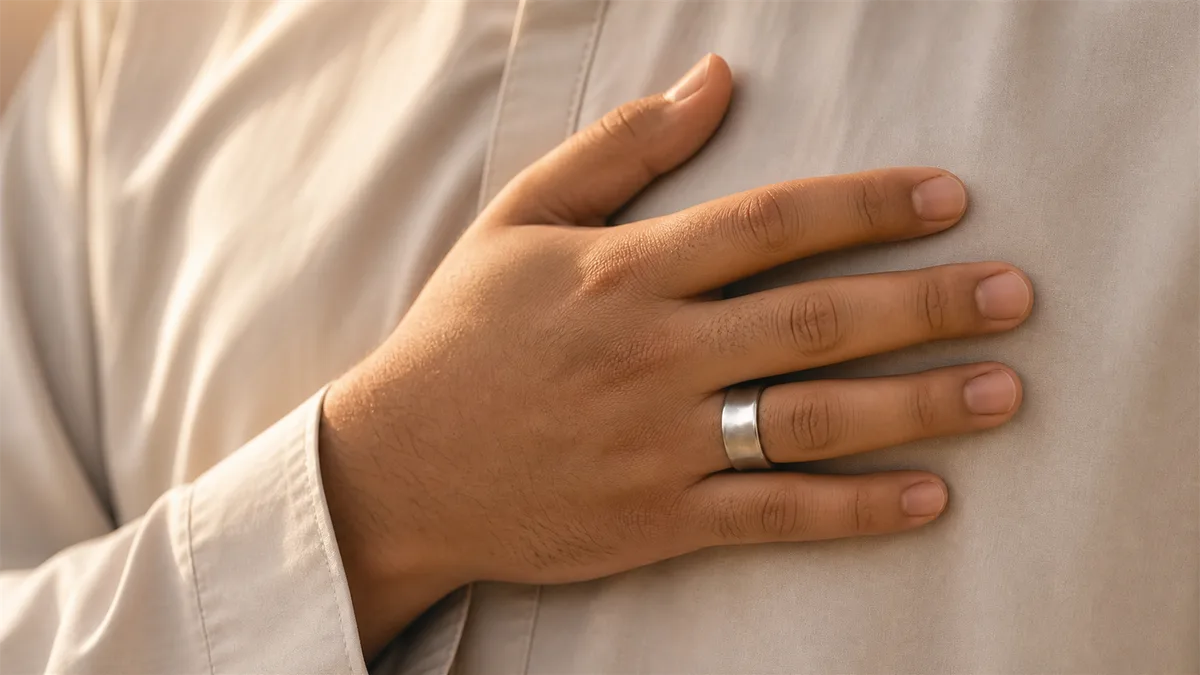
How do you keep khushu, real presence, during dhikr? Presence improves when counting stops competing for your attention. The point of any counting aid, beads or ring, was never to rack up the highest number. Rather, it was to offload the counting so the mind can rest on the meaning. Egypt’s Dar al-Ifta, citing the classical scholar al-Suyuti’s own treatise in defense of prayer beads, holds that a counting aid can even be better than counting on the fingers when it guards against mistakes and lets the heart concentrate³.
Modern rings earn their place the same way, by getting the arithmetic out of your head.
Modern attention research points in the same general direction. When a small repetitive task is handled for you, there’s more room to settle on the words themselves. Harvard Health Publishing even lists repetitive prayer among six relaxation techniques that calm the body and quiet the mind⁴. We won’t overstate the science or pin it to specific brain chemistry; the direction is what matters, and it lines up with the old wisdom.
What does this look like in practice? Keep it small and anchored. One short, unhurried dhikr you actually feel beats a rushed hundred you don’t. Tie it to fixed moments, after a prayer, on the walk to work, in the last minutes before sleep. And when your mind drifts, just return. Wandering isn’t the problem; staying wandered is. A silent ring you never glance at protects that return far better than a number you keep checking.
Smart Dhikr Ring vs Tasbih Beads: A Problem-by-Problem Comparison
Neither beads nor a ring is “more Islamic,” so choose by the problem you keep hitting, not by feel. Prayer beads have accompanied dhikr for many centuries and still win on tactile ritual and zero-tech simplicity. Where the ring wins is different: it never loses count, stays silent in public, reminds you at prayer times, and tracks your streak. Both serve the same remembrance.
Here’s the honest side-by-side, mapped to where daily dhikr actually breaks.
Where dhikr breaks | Tasbih beads | Smart tasbih ring |
|---|---|---|
Losing count mid-session | Easy to lose your place if you set them down | A press keeps the tally, so the count holds |
Remembering to start | Nothing prompts you | A silent vibration can nudge you at prayer times |
Discreet use in public | Visible, and beads can click | Silent and glance-free on your finger |
Staying present (khushu) | Grounding, tactile rhythm | Offloads the count so attention rests on meaning |
Tracking the habit | No record is kept | The app logs daily streaks |
Wudu and water | Simple, nothing to protect | Manufacturer-stated IP67, fine for wudu, not swimming |
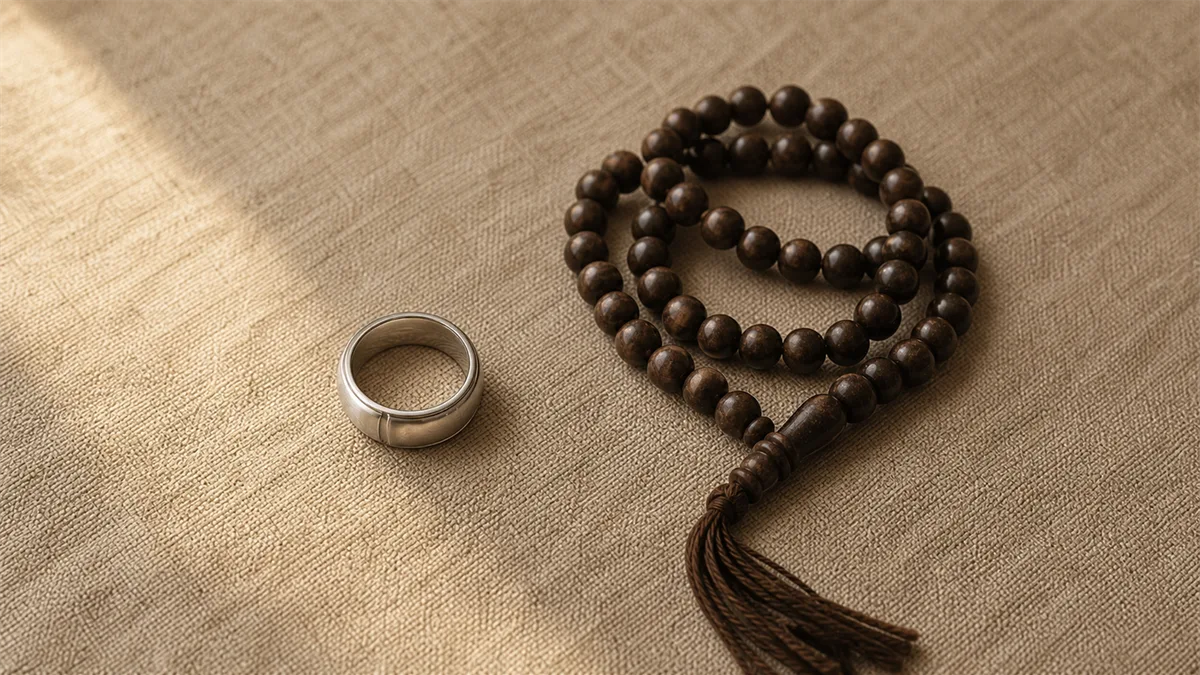
So does a smart tasbih ring count on its own? No, and that’s deliberate. You register each dhikr with a press. Motion-based auto-counting is unreliable: Höchsmann and colleagues (Physiological Measurement, 2020) recorded a wrist tracker running up to 215% over the true step count while its wearers simply sat, ordinary hand movement read as motion⁵. Pressing it yourself keeps the count honest. Aids change with the century; the dhikr doesn’t.
What Makes the Best Smart Dhikr Ring (Buyer’s Checklist)
Honestly, the best smart dhikr ring is the one you’ll actually wear all day, so fit and discretion should outrank spec-sheet bragging. Here’s the short checklist that actually predicts daily use:
Comfortable full-ring form you’ll keep on all day, not one you quietly set aside by noon.
A reliable silent reminder that nudges you, no sound at all.
Easy charging with wudu-safe water resistance, so ablution, handwashing, and a walk in the rain are no worry.
Honest streak tracking that celebrates your return, never scolds a miss.
A manual press that won’t miscount, so the tally stays true to every dhikr you actually said.
From what we’ve seen, daily wearability is the spec that decides whether it ever leaves the drawer.
Look closely at streak tracking, and pick the kind that encourages rather than scolds. In a 2023 Journal of Consumer Research paper, Silverman and Barasch found an intact streak lifts engagement, while spotlighting a broken one can quietly demotivate⁶. So we’d rather a ring celebrate your return than shame a missed day. Every Dhikr Matters, including the ones you almost skipped.
So how do you read the reviews fairly? Many low ratings are really expectation mismatches: someone expected the ring to count automatically, or to speak the qibla out loud, and it does neither by design. Sort those out from the genuine gripes. And be honest with yourself about the sample, because this is a young category with few large, independent review sets, so no single star rating tells the whole story yet. Weigh fit, feel, and how you actually pray over any leaderboard.
WESLAMIC Smart Dhikr 3.0 (Peace1): A Presence-First Daily Ring
WESLAMIC Smart Dhikr 3.0, the iTasbih-Peace1, is our first full-ring design, built for quiet, all-day wear. It looks like a clean modern ring, not hardware on your hand. On your finger it keeps a smart dhikr count, offers a customizable silent vibration for prayer and dhikr reminders, tracks your streaks in the free app, and carries everyday water resistance that’s friendly to wudu. The aim is presence, not winning a spec race. We’d rather it read as faith jewelry than as one more thing to tolerate on a busy day.
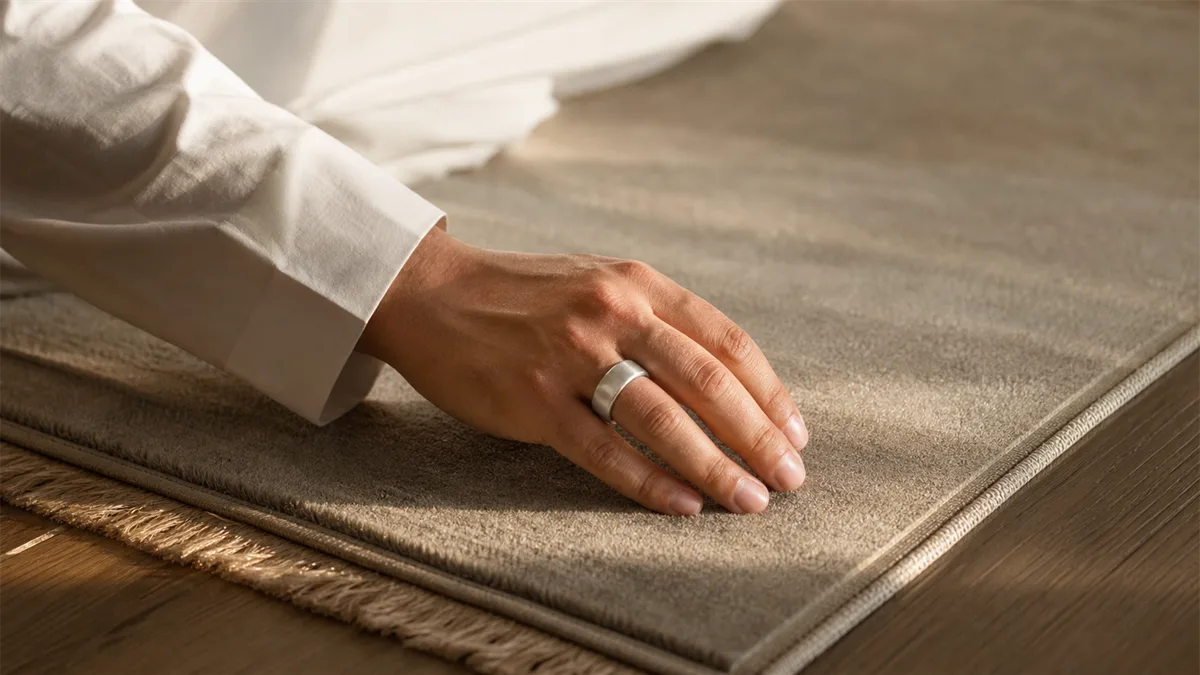
Not sure which iTasbih fits your daily dhikr? Pick by how you want to live it, not by parameters.
iTasbih-Salam: a friendly, budget-easy way into a daily dhikr habit, and a warm Ramadan or Eid gift for someone just entering the faith.
iTasbih-Faith: the tried-and-true daily pick, pairing a quiet prayer-time reminder with app-based streak building, in five sizes to suit most fingers.
iTasbih-Relation: a light-luxury metal finish with a long-lasting charging case and a built-in NFC card for sharing contact or da’wah, a heartfelt Eid or Ramadan gift.
iTasbih-FIT: the balance pick for a disciplined, healthy life, pairing dhikr with health tracking and Fajr check-ins.
Whichever you choose, the intent holds: a ring that witnesses your dhikr, never one that nags you about it.
Smart Dhikr Ring FAQ: Counting, Halal, Wudu, and Phone-Free Use
Does a smart tasbih ring count automatically?
No. You register each dhikr with a single press, which is deliberate rather than a shortcoming. Motion-based auto-counting misreads ordinary hand movement, as the comparison above shows, so a manual press stays far more accurate. It also keeps you in charge of the count, which quietly helps your focus instead of pulling your eyes to a screen mid-remembrance.
Is a smart dhikr ring halal or bid’ah?
Most contemporary scholars treat a counting aid as permissible, not an innovation, since counting dhikr is a means to worship rather than worship itself. As of 2026, multiple contemporary fatwa bodies, including Egypt’s Dar al-Ifta, land there³, though it isn’t meant for use inside the formal salah, which carries its own conditions. That is the mainstream position, not a personalized fatwa; for a verdict that fits your own circumstances, put the question to a qualified local scholar. The fuller reasoning across the four Sunni schools sits on are zikr rings halal.
Can I wear it during wudu?
Generally yes. Our rings carry a manufacturer-stated IP67 rating, an IEC 60529 classification, so they handle wudu, handwashing, and rain without worry. What they aren’t built for is swimming, hot soaks, or a sauna, so take the ring off for those. A quick dry after wudu also keeps a press-based count from registering a stray touch.
Can a smart tasbih ring count without your phone?
Yes. Your count is stored on the ring itself, so dhikr carries on whether the phone is across the room, in another bag, or on airplane mode. The free companion app, on both iOS⁷ and Android⁸, is what layers in prayer-time reminders and streak history. Treat the phone as optional backup, not the main event.
How is it different from tasbih beads?
The count is the same worship; the difference is what each protects. Beads give you a tactile, grounding rhythm with nothing to charge. A ring never loses count, stays silent in public, can remind you at prayer times, and records your streak, as the comparison section lays out. Many people keep both and reach for whichever suits the moment.
Can a man wear a smart dhikr ring?
Generally yes. The restriction in question centers on gold and silk, so non-gold finishes are where most scholars land for men, and many iTasbih pieces are chosen with that in mind. The full material-by-material reasoning sits on can men wear rings in Islam.
Reviewed by the WESLAMIC Editorial team. This article is educational and does not issue a fatwa; for personal religious rulings, please consult a qualified scholar you trust.