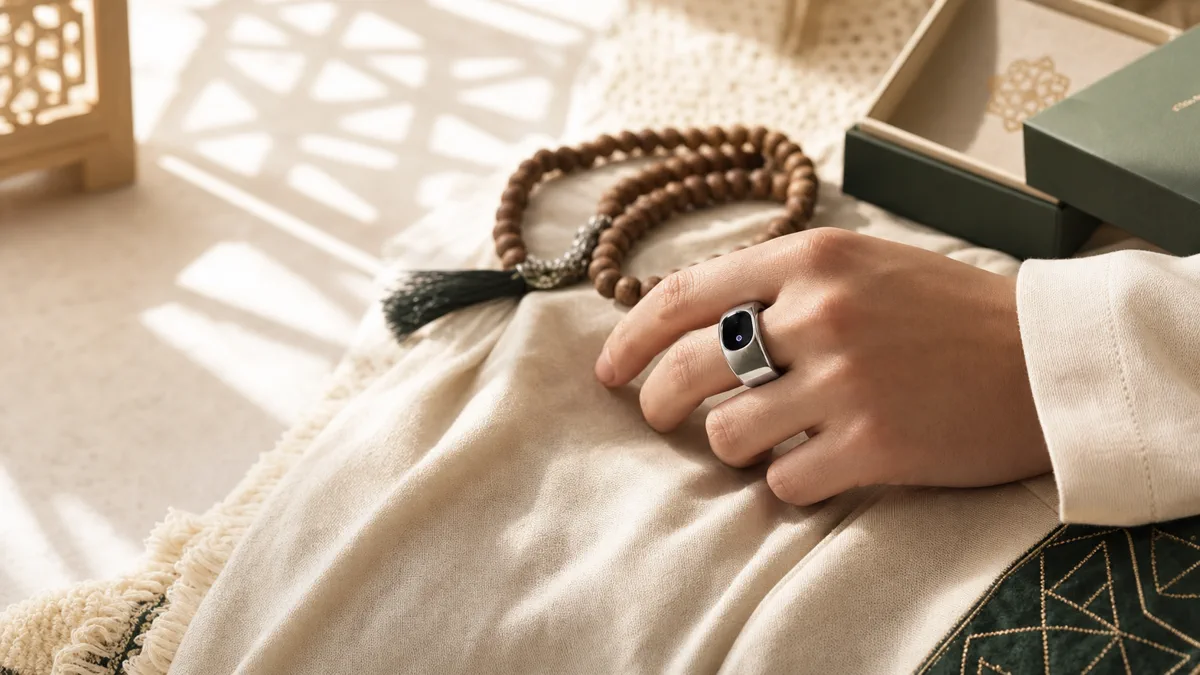
Thirteen paths, three lenses: meaning, design, and technology.
Most faith jewelry asks only to be seen, worn as a quiet sign that someone believes. This page marks a turn. A piece can now do more than stand for remembrance; it can help you keep it.
Type “faith jewelry” into most stores and you get general-retail, faith-neutral “spiritual” pieces. Nothing is built for Muslim remembrance, and everything treats jewelry as a symbol to display rather than a practice to live. You’re left choosing by looks alone. This hub hands you a map instead.
Key Takeaways
Faith jewelry is belief you can wear, not just a symbol you display.
For Muslims, the shift is from a symbolic pendant to remembrance you practice all day.
Early Muslims counted dhikr on fingers and pebbles before beads, per Wikipedia’s Misbaha entry¹; the form changes, the remembrance does not.
Scholars treat remembrance you wear as a permissible aid, with the fingers still the Sunnah.
Choose by the role a piece plays, not its spec sheet.
What “Faith Jewelry” Means When Belief Becomes Wearable
Faith jewelry is anything you wear that takes part in your faith, not only signals it. For Muslims, that meaning has moved: from a symbol you display to remembrance you practice. WESLAMIC frames this as “presence over counting.” A piece earns its place by making each dhikr easier to happen, not by how many it records.
Here’s the shift in one line: a symbol represents your faith, a practice joins in. A pendant says “I believe.” A dhikr ring helps you remember, right there on your finger, during a commute or a slow afternoon. The belief is the same. What changes is whether the jewelry takes part.
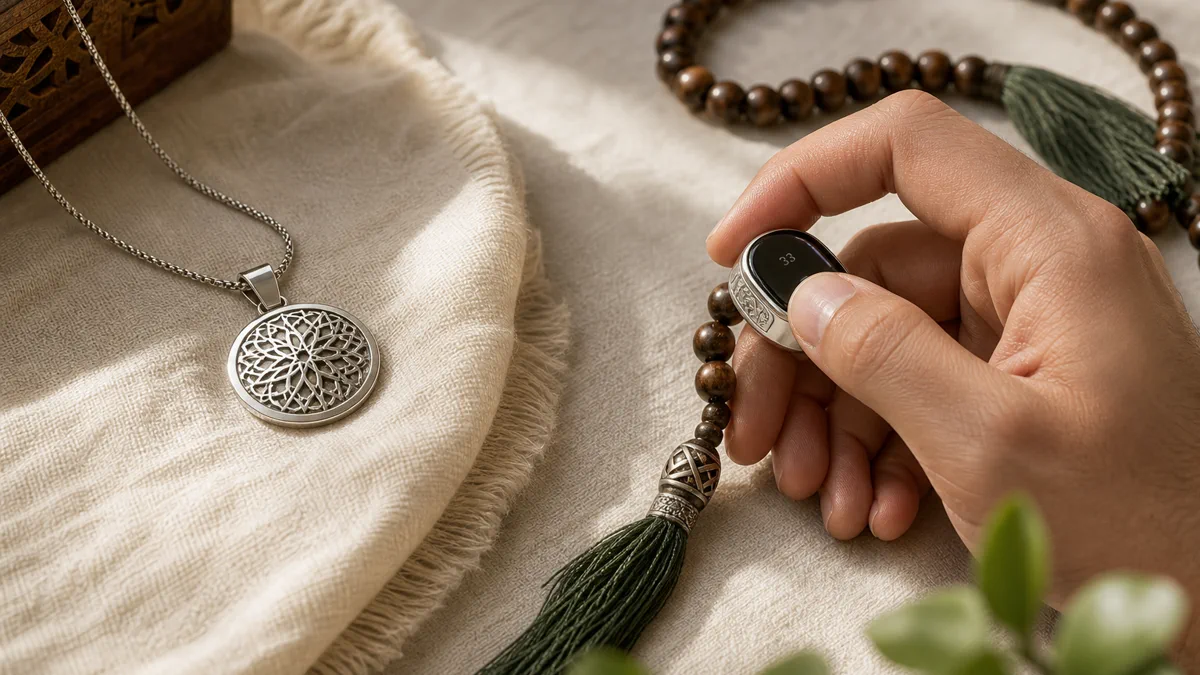
This isn’t a break from tradition. It’s the next link in an old chain. Early Muslims counted remembrance on their fingers and with pebbles, and prayer beads entered the practice later, as Wikipedia’s Misbaha entry records.¹ Knotted strings, then beads, then electronic forms, now a ring you wear. The shape keeps changing. The remembrance does not.
Is wearing it allowed? In short, yes, as an aid. A dedicated ruling on the tasbih ring (IslamQA.info, answer 198080) treats it as a permissible means to help dhikr, while noting the Sunnah is to count on the fingers and cautioning against wearing anything for show.²
Scholars have addressed electronic forms too. A ruling on the electronic tasbih (IslamQA.info, answer 128914) reasons that if beads are allowed, the electronic form may be as well, while still calling the fingers better.³ Jordan’s General Iftaa Department (fatwa 337) affirms the same, citing companions who used pebbles and knotted strings.⁴ We share these rulings for context only; the verdict isn’t ours to give. For the fuller picture, see are zikr rings halal.
Three Ways to Explore Faith Jewelry: Meaning, Design, and Technology
Modern Muslim faith jewelry splits into 13 paths, and three lenses make that breadth easy to navigate. WESLAMIC sorts them by why you wear a piece, how it looks, and what it can do. The three Explore sections below, Explore by Meaning, Explore by Design, and Explore by Technology, route you straight into each path.
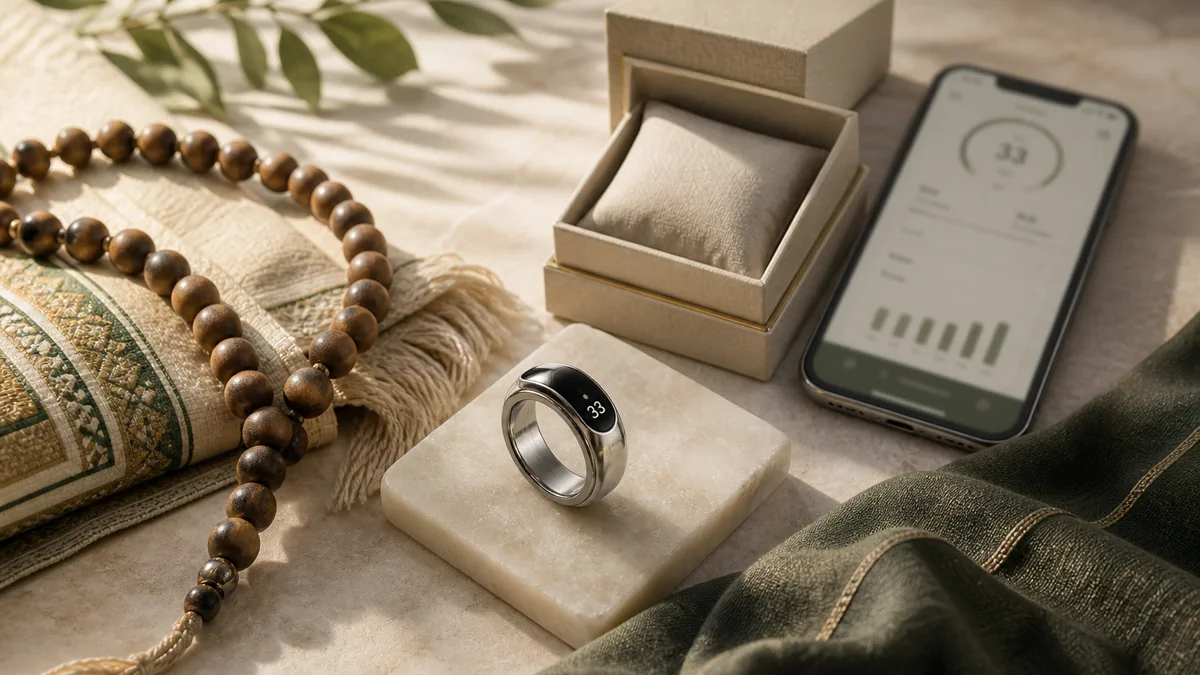
The first lens is meaning. This is the “why you wear it” layer: what remembrance a piece carries, what intention it holds. Some readers come here for symbolism and the spiritual weight of dhikr, not the hardware. That’s the heart of the whole category, and most paths trace back to it. It opens up in Explore by Meaning below.
The second lens is design. This is the “how it looks and feels” layer: modern, pared-back, quiet enough for daily wear. WESLAMIC calls its aesthetic digital Islamic minimalism, which means keeping the meaning, quieting the hardware, and amplifying calm. Plenty of people want faith jewelry that reads as good jewelry first; that thread runs through Explore by Design.
The third lens is technology. This is the “what it can do” layer: smart pieces that gently support your remembrance through the day. Not everyone needs this layer, and that’s fine. When you do want it, it should feel like a companion, never a supervisor, and Explore by Technology covers it in full. Which lens matters most to you? That’s usually the fastest way in.
The lenses overlap, by the way. One ring can hold meaning, look like clean modern jewelry, and carry a little intelligence at once. You’re not picking one and losing the rest; you’re choosing which one leads.
How to Choose Faith Jewelry by the Role It Plays, Not the Spec Sheet
The easiest way to choose faith jewelry is by role, not spec sheet. We sort the decision into three roles: a private daily anchor, a quiet identity statement, or a connected companion. Pick the job you want the piece to do, and the right one gets obvious. The best piece is simply the one you keep wearing.
Want a private daily anchor? Start simple. Our WESLAMIC iTasbih-Salam is the gentlest way in, and the classic iTasbih-Faith is the all-rounder that fits almost everyone, gift-boxed and easy to live with. If sizing matters, the iTasbih Faith line comes in five sizes, with the Faith+ spanning 16 to 24mm, so it sits right on more hands. There are softer expressions too, like the Lavender style, a Faith Couple Set for two, and a Faith Smart NFC set for sharing a salam.
Want a quiet identity statement, something design-led? Look at the iTasbih-Peace1, our first full-ring shape that reads as a simple modern ring you’d wear for its own sake, light enough for all-day comfort. For a gift with more ceremony, the iTasbih-Relation adds a metal finish and a boxed, occasion feel, the kind of present that carries weight at a wedding or Eid.
Want a connected companion? The iTasbih-FIT ties remembrance to daily rhythm, pairing dhikr with heart-rate, sleep, and a gentle Fajr check-in, so faith and health sit on one finger. In our experience, people don’t pick a role off a spec list. They picture a moment, a morning, a gift for a mother or a husband, and choose from there. Not sure how a ring fits an ordinary day? See how to use zikr ring.
Where Faith Jewelry Fits: The Space Two Big Markets Leave Empty
Faith jewelry for Muslim remembrance sits in a gap between two crowded markets. As of 2026, most smart rings are built around health, tracking sleep, heart rate, and steps, while mainstream spiritual jewelry sells meaning and identity but stays faith-neutral, with no real way to practice. Neither was made for dhikr. So where does that leave a Muslim who wants both? Picture it as a simple grid.
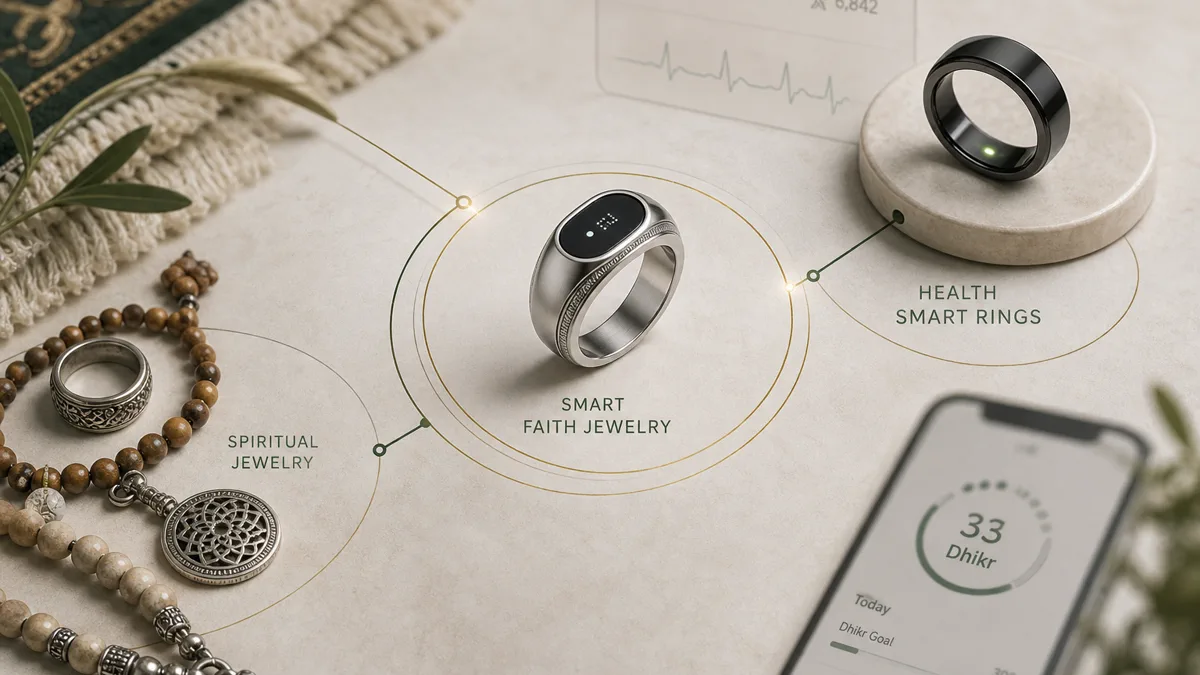
Carries faith and remembrance | Faith-neutral | |
|---|---|---|
Active, smart function | Muslim remembrance: largely empty, and where WESLAMIC builds | Health smart rings |
Decorative only | Spiritual jewelry | Everyday jewelry |
Our finding: Across the jewelry and wearables we track, spiritual pieces sell meaning without practice, and smart rings sell practice without faith. The cell for Muslim remembrance, both beautiful and able to join your dhikr, sits largely empty.
That empty cell is where WESLAMIC built. In our own words, it’s the first smart faith-jewelry brand: pieces meant to be worn, gifted, and lived with, not filed under hardware. The aim isn’t to out-feature a fitness ring or out-pretty a pendant. It’s to make remembrance easier and lovelier at once, in keeping with one idea: every dhikr matters. To see the whole family in one place, See all smart tasbih ring.
Explore by Meaning
Start here if you care most about what a piece carries, not how it looks or what it tracks. These six paths sit closest to the heart of remembrance.
Why a dhikr ring carries weight
A dhikr ring turns a tally into a feeling: each turn is a breath of remembrance, not a score to beat. There’s real symbolism in that small loop. To unpack what a dhikr ring means and why it resonates, our dhikr ring meaning page walks through it slowly.
A ring made for remembering Allah
Some readers want the intention first: a piece chosen to keep the heart turned toward Allah through an ordinary day. If that’s you, the ring for remembrance of Allah page speaks to that niyyah directly, gently, and without any pressure to perform.
Spiritual jewelry, read through a Muslim lens
Spiritual jewelry is a broad shelf, and much of it isn’t built for Islamic practice. Our guide to spiritual jewelry muslim sorts what genuinely fits Muslim remembrance from what only borrows the language of it, so you can choose with clarity.
The wider world of dhikr jewelry
Beyond rings, remembrance takes many wearable forms. The dhikr jewelry page maps the full category, from quiet everyday pieces to gift-worthy ones, so you can see where each kind belongs before you settle on a single style.
Remembrance you actually wear
There’s a difference between owning a tasbih and keeping one with you. The wearable dhikr page is about that habit: remembrance that travels on your hand through the day, asking nothing back, with no streak to protect and no count to chase.
Faith jewelry, made for Muslims
General faith pieces rarely speak to Islamic practice. Our overview of faith jewelry muslim gathers the styles, meanings, and gifting moments that actually fit Muslim life, in one calm starting point for anyone new to the idea.
Explore by Design
Choose this lens if you want faith jewelry that earns its place as jewelry first, quiet enough to wear every day. These three paths are about look and feel.
Contemporary takes on Islamic jewelry
Faith and modern taste aren’t at odds. The modern islamic jewelry page shows how today’s pieces keep their meaning while shedding dated styling, made for people who dress simply and choose what they wear with intention.
Pared-back pieces for everyday wear
Less really can be more on the hand. Our minimalist islamic jewelry page is for readers who want the smallest, calmest expression of faith: something that slips into a daily outfit, never shouts, and still means everything.
Where modern, Muslim, and minimal meet
Some shoppers want all three at once: current design, clear Muslim meaning, and a quiet footprint. The modern muslim minimalist jewelry page lives right at that intersection, for the understated wearer who still wants their faith present.
Explore by Technology
Come here when you want a piece that gently supports your remembrance, not just represents it. These four paths cover the smart side of faith jewelry, companion-style.
Smart pieces that hold your dhikr
When you want remembrance plus a little quiet help keeping it, smart pieces step in. The smart dhikr jewelry page explains how a connected piece can support your practice without nagging, counting against you, or turning worship into a scoreboard.
Smart jewelry, designed for Muslims
Most smart jewelry is faith-neutral by default. Our islamic smart jewelry page covers pieces built with Muslim practice in mind, where the intelligence quietly serves the remembrance instead of pulling your attention toward metrics you didn’t ask for.
The tasbih, reimagined to wear
A tasbih you carry can become a tasbih you wear. The wearable tasbih page looks at how the familiar prayer-bead habit moves onto the hand as a ring, keeping the rhythm you know while losing the loose, easy-to-misplace beads.
Wearable technology, on Muslim terms
Wearables usually optimize the body, not your worship. Our islamic wearable technology page asks a different question: what would wearable tech look like if it were shaped around faith and daily practice first, with health as the companion rather than the point?
Frequently Asked Questions
What is faith jewelry?
Faith jewelry is anything worn to express belief, and for Muslims today it has grown past the symbolic pendant: smart faith jewelry, like a dhikr ring, can keep your remembrance going through the day rather than only standing for it. This hub maps 13 paths across three lenses. New to the idea? See what is zikr ring.
What makes modern Muslim faith jewelry different from a symbolic pendant?
A pendant is worn and then mostly forgotten; it sits there and signals. Modern Muslim faith jewelry stays with you through the day and offers a little companionship in your dhikr. The real difference is lived, not technical: no streak to keep, no count to chase, and no guilt if you pause. It asks nothing back.
How do I choose faith jewelry, by role or by spec?
By role, not by spec sheet. Decide whether you want a private daily anchor, a quiet identity statement, or a connected companion, then match that intent to a sub-category above. The right piece is simply the one you keep reaching for. For the everyday habit side of it, see how to use zikr ring.
Is a dhikr ring or faith ring halal in Islam?
In short, remembrance you wear is welcomed as an aid, and it’s meant to add calm, not obligation. Scholars treat counting aids as permissible while noting the fingers remain the Sunnah, so intention and humility matter more than the object itself. We don’t issue rulings here; for the full, balanced answer, see are zikr rings halal.
Is faith jewelry a good gift, and can men wear a faith ring?
Yes on both. A faith piece is a warm relationship gift for Ramadan or Eid, whether for a wife, a parent, a friend, or a husband, and it carries more meaning than most presents. Men wear faith rings too, with a few etiquette points worth knowing. For those, see can men wear rings in Islam.
About This Page
Reviewed by the WESLAMIC Editorial team, the in-house writers and editors who maintain WESLAMIC’s faith-and-product guidance; see our About page for editorial standards and contact. This hub is informational and does not issue religious rulings (fatwa); for personal guidance on practice, please consult a qualified scholar.
Related reading: dhikr ring meaning and smart dhikr jewelry.
Sources
2. IslamQA.info, answer 198080, “Ruling on using a tasbih ring,” retrieved 2026-06-30
3. IslamQA.info, answer 128914, “Ruling on tasbih using the electronic masbahah,” retrieved 2026-06-30
4. General Iftaa Department of Jordan, fatwa 337, “Ruling on using Beads,” retrieved 2026-06-30
WESLAMIC internal brand documentation (brand positioning and product notes), reviewed 2026-06-30