
Mid-meeting, the azan alarm goes off, loud, and every head turns. You silence it fast and promise yourself you’ll catch Dhuhr later. Sound familiar? Or your phone sits buried in your bag on the train, and Asr slips past without a whisper. Phone-first reminders keep failing at the exact moments they were meant to serve.
There’s a quieter route, one that moves the cue from a speaker to your skin. Below, we cover how the silent vibration works, how a ring compares with a watch or an app, and which WESLAMIC smart dhikr rings carry the reminder heading into 2027.
Key Takeaways
Unlike a phone alarm, the tap asks nothing back: no unlocking, no screen to check, and it still lands when your phone is buried in a bag.
Beyond reminding you, the tap can double as a micro-relaxation cue: silently repeating a short prayer is one of the six techniques on Harvard Health Publishing’s stress-reduction list¹, so the cue that reminds you is also the practice that settles you.
As of mid-2026, three of the five WESLAMIC rings carry the on-ring reminder.
Faith and Relation tap in one set pattern; Peace 1 is the only model that lets you choose the vibration pattern yourself.
How a Smart Ring Reminds You to Pray: Silent Vibration vs. Phone Alarm
A smart dhikr ring pulls your local prayer times from the connected WESLAMIC app, then sends a gentle vibration to your finger as each of the 5 daily times arrives. Unlike a phone azan alarm that rings out loud, the ring’s reminder is silent and private.
This category grew out of a small, daily friction: the phone azan is loud in the wrong rooms and mute in the wrong bags. In an open office, it announces you to everyone. On a commute, it drowns under noise. At home, it competes with every other notification until you swipe it away like the rest. Putting the cue on your body changes that: silent vibration reminders, no sound, no screen.
So how does the tap know when to arrive? Three links:
First, the app sets the times. As of July 2026, WESLAMIC’s Faith product page states that prayer times are calculated automatically from your real-time location², all five of them, every day.
Next, the connected app passes each time to your ring. There’s nothing to program on the ring itself.
Then the ring answers at the moment of salah with a gentle vibration on your finger. “Gentle” is the brand’s own word for it, and it’s the right one.
That’s the whole sensory difference in one line: a phone announces the time to the room, while the ring mentions it to you. What changes is the delivery, not the deen. Secrecy isn’t the point; the point is that the moment stays yours. You don’t reach for anything, you don’t unlock anything, you simply know, and you can finish your sentence, stand, and go. For the full wearing-and-use walkthrough, from sizing to daily dhikr, see how to use zikr ring.
Two practical notes before you compare formats. Setup takes minutes; we walk through it in the setup section below. And not every model carries the on-ring cue, so check the model table further down before you choose.
Ring vs. Watch vs. App: Which Wearable Prayer Reminder Fits Daily Life?
Of the 3 common formats for a salah reminder (a ring, a smartwatch, or a phone app), the ring is the most discreet for all-day wear: it sits on your finger, needs no screen, and signals with a silent touch. Smartwatches buzz but invite a glance at notifications; phone apps are easy to silence and forget.
Most category guides compare apps and watches and skip the ring entirely. So we’ve put all three side by side the way you’d actually live with them, scene by scene.

Scene | Smart ring | Smartwatch | Phone app (the non-wearable default) |
|---|---|---|---|
In a meeting | Just a touch, and only you notice it | Buzz plus a lit screen on your wrist | Sound or banner the room can catch |
On public transit | Lands even with your phone in your bag | Lands, then invites the notification scroll | Easy to miss in a pocket or bag |
Around sleep and Fajr | Soundless cue that doesn’t wake the room | Screen glow at the bedside | Full alarm, or nothing at all |
How easy to ignore | You feel it on skin | One swipe dismisses it | One tap mutes it for good |
What it asks of you | Nothing to check | One quick glance | Unlock, open, respond |
So which one actually respects your attention? In our experience, a ring is the only format of the three you can answer in a meeting without anyone else noticing a thing. Watches come close, but the lit screen tends to pull you toward everything else waiting there. And the app, today’s default, depends on the one thing many of us are trying to look at less.
One honest note on all-day wear: some men hesitate at the idea of a ring at all. That question deserves its own unhurried answer, and it has one: see can men wear rings in Islam.
If quiet, all-day discretion is your deciding factor, a smart dhikr ring like WESLAMIC’s is the format built for it. Which of ours carry the reminder? That’s next.
Which WESLAMIC Smart Dhikr Rings Have a Prayer Reminder?
Three WESLAMIC rings carry the prayer-time reminder (iTasbih Faith, iTasbih Relation, and iTasbih Peace 1), each using a built-in vibration to mark salah times. Salam and the health-focused FIT don’t carry the on-ring cue, so pick from those three if reminders matter most.
Buying is where it gets confusing. More than once, we’ve seen third-party listings mislabel which models vibrate, or even file WESLAMIC rings under iQIBLA. So treat the table below as the from-the-source record. Current as of July 2026.
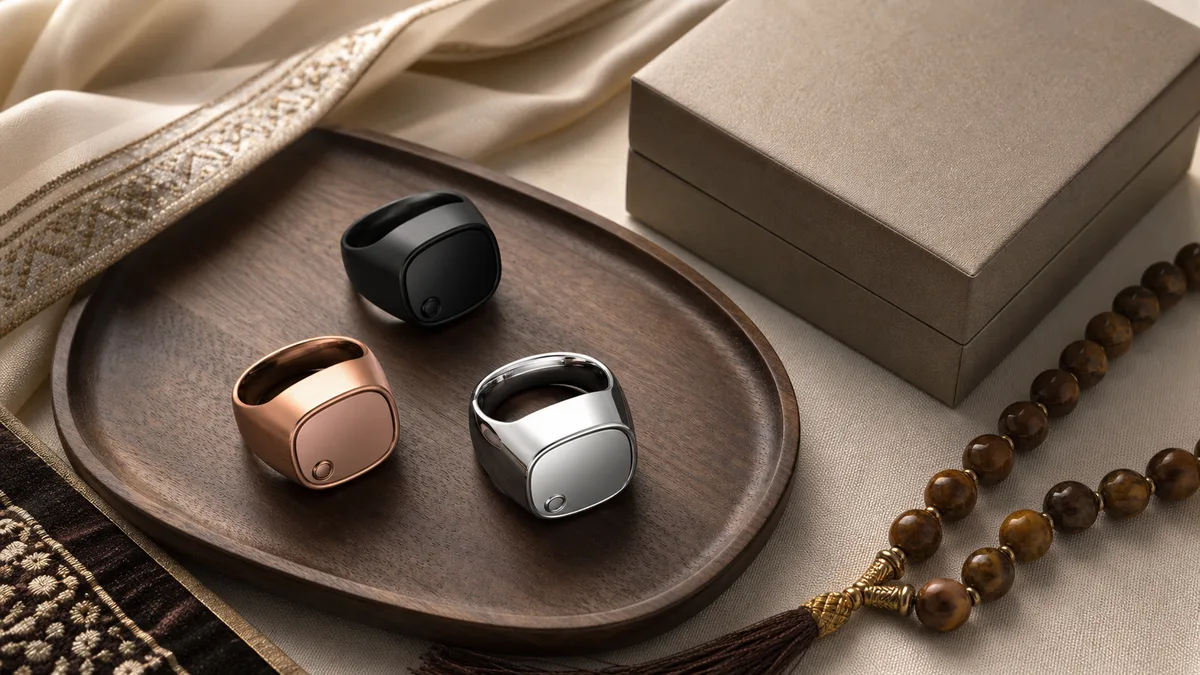
Model | On-ring prayer reminder | In one line |
|---|---|---|
iTasbih Peace 1 | Yes (built-in vibration motor) | Full-circle design that reads as a simple modern ring, light enough for 24-hour wear |
iTasbih Faith | Yes | Classic gentle daily tap, in Faith+ Black, Rose Gold, or Saudi Purple |
iTasbih Relation | Yes | Refined metal with a gift-box feel, made for weddings and Eid |
iTasbih Salam | No (dhikr counting only) | Simple, meaningful first step |
iTasbih FIT | Skips the on-ring vibration cue (no motor); the app still offers azan reminders and a Fajr Tracker | Faith habits plus sleep and morning rhythm in one ring |
Our finding: Peace 1 is the only model that pairs its built-in motor with customizable prayer-reminder vibration patterns, and its store listing itself carries the line “Newly launched vibration alert function.” That makes the reminder a shipping feature today, not a roadmap promise.
Salam and FIT aren’t lesser choices, just different ones. Salam keeps a first step into Smart Tasbih Jewelry simple and warm, while FIT trades the motor for sleep and Fajr-rhythm care. One more Smart Tasbih 3.0 sibling, iTasbih Nawa, is on the way; we’ll share details when it launches rather than guess at them here.
Whichever way you lean, every model here belongs to the same zikr ring family, and they’re easier to compare in one place. Want them side by side? See all smart tasbih ring models on one page.
A Gentle Tap, Not a Nagging Alarm: Reminders That Bring Calm
Prayer reminders should lower the noise in your day, not add to it. Harvard Health Publishing counts silently repeating a short prayer among its six relaxation techniques for reducing stress¹, and that’s the direction we build in: a cue designed to settle you, not to summon you.
Much of reminder culture is built like a scoreboard. Streaks, badges, red dots, the quiet arithmetic of falling behind. We build in the opposite direction. Every Dhikr Matters is the whole of our philosophy: each small turn toward Allah counts, and none of them should arrive wrapped in guilt.
Feel a reminder and it’s an invitation; let everyone hear it, and prayer can turn into a performance. That’s why the tap is soundless, and why the ring looks like a ring rather than a screen.
Why does something so small feel so different? Because it flips who the reminder serves. Alarms serve the schedule, full stop, and they’ll keep serving it whether you’re ready or not; a tap serves you. No questions about whether you prayed on time yesterday. Today’s moment gets offered, quietly, and the ring waits.
This is also why we make faith jewelry rather than another glowing rectangle for your body: something you’d wear for its own sake, that happens to remember the times for you.
How to Set Up Prayer Time Reminders on Your Ring
Setup takes 3 steps and a few minutes; after that, the app works on its own, sending each of the 5 daily prayer times to your ring day after day with nothing left to program.
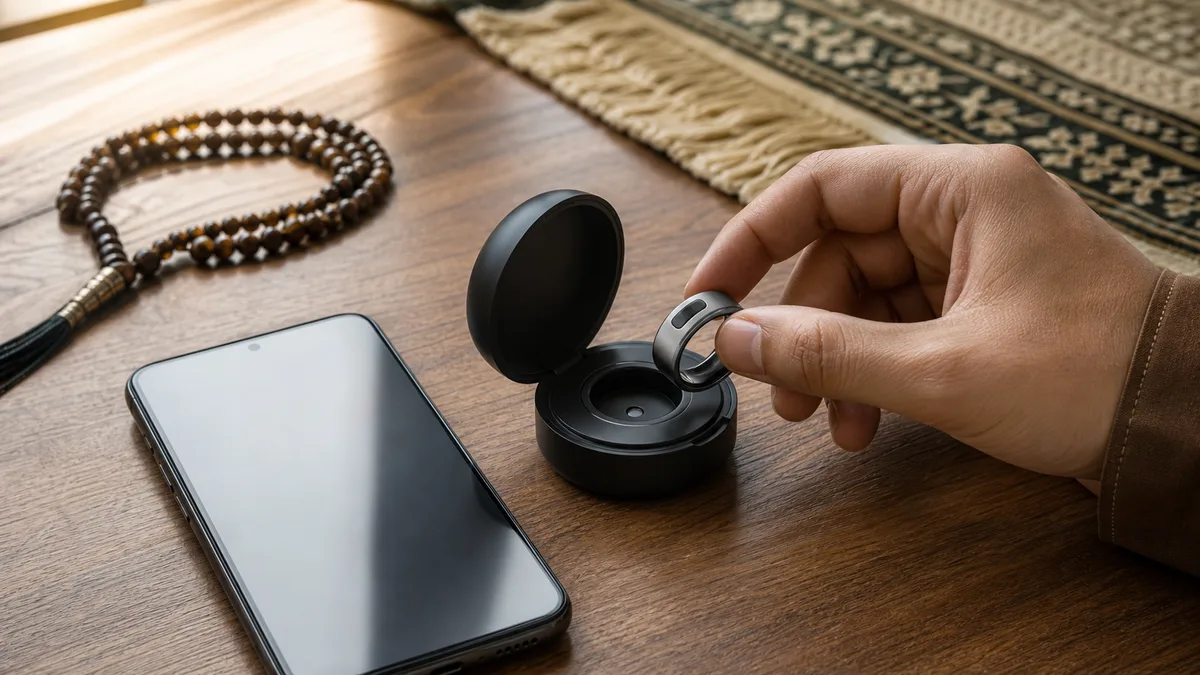
Here’s the walkthrough:
Download the WESLAMIC app on your phone, and allow Bluetooth and notifications when it asks; that’s how the app reaches your ring.
Connect your ring inside the app. Pairing takes a minute or two on the guided screen; keep the ring close to your phone while they find each other.
Allow location access, so the app can calculate each day’s times wherever you actually are. No manual timetable, no city lists to update.
That’s it. On Peace 1, you can go one step further and choose the vibration pattern that feels right to you, so the reminder arrives in your own accent, so to speak.
What about when you fly? Nothing to do; the travel question in the FAQ below covers exactly how the schedule follows you.
What Is a Wearable Prayer Reminder?
A wearable prayer reminder is salah timekeeping you wear: a ring, band, or watch that marks each of the five daily prayer times with a quiet vibration on your body instead of an alarm from your phone. It suits anyone with a busy, phone-light, or public schedule: the commuter, the professional in meetings, the student, and the traveler each move through a setting, the train, the meeting room, the classroom, the road, where a quiet cue for salah beats pulling out a phone.
Picture them one by one. Commuters first: the train is loud, your phone’s buried in your bag, and the tap still lands on your finger exactly when it should. Professionals? We made the meeting case above. Students sit in classrooms that ask for silence, and the ring obliges without going quiet on you. And travelers have nothing to reconfigure when they land; the FAQ below explains why.
And if you’re newer to the deen, the ring can help the rhythm of the daily prayers settle in gently, with no ledger of misses waiting for you. Still weighing whether wearing one is appropriate at all? Start with are zikr rings halal.
There’s a soft signal in the research, too. In 2019, a small quasi-experimental study of 40 cancer patients, published in the Asia-Pacific Journal of Oncology Nursing, found dhikr therapy markedly reduced anxiety (effect size 0.87)³. One small study in one setting, so we hold it lightly, but the direction won’t surprise anyone who prays.
If this sounds like your daily life, you could begin with one of the three reminder-equipped models above and let the day’s rhythm come to you. See all smart tasbih ring options when you’re ready. However you choose, the promise stays the same: a companion’s tap, not an alarm.
Frequently Asked Questions
Can a wearable prayer reminder replace the azan?
No, and it isn’t meant to. Where the azan is a public call, the ring is a private cue that reaches you 5 times a day when no call is within earshot: an office, a classroom, a train. Many wearers treat it as a quiet companion to the azan, never a substitute. For questions of practice, ask a qualified scholar.
Which WESLAMIC ring makes the best gift when reminders matter?
Start with the reminder-equipped models in the table above, then choose by style. Peace 1 suits low-key, 24-hour wear; Faith is the classic in several finishes; and Relation arrives gift-boxed for weddings and Eid. All three pair in minutes. And each makes a meaningful gift, one that taps rather than pings.
Will the reminders keep up when I travel?
Yes. Per WESLAMIC’s Faith product page, prayer times are calculated automatically from your real-time location², so all 5 daily reminders arrive on local time wherever you are. There’s no timetable to edit and no city list to maintain. Land, keep your ring on, and the day’s rhythm re-forms around you.
Does the iTasbih FIT remind you to pray?
Not on your finger. FIT in its current version skips the on-ring vibration cue, since it carries no vibration motor, though the WESLAMIC app still offers azan reminders and a Fajr Tracker⁴. If the silent tap is the point of your purchase, choose one of the 3 reminder models in the table above.
Reviewed by the WESLAMIC Editorial team. WESLAMIC does not issue religious rulings; for questions of worship and practice, please consult a qualified scholar.