
Most reviews of a Ramadan digital tasbih ring read like spec sheets. They rank whatever counts highest and costs least, as if Ramadan were an ordinary month. It isn’t. Fasting reshapes your whole day, and the ring on your finger lives through every hour of it.
So this guide scores every ring against the month itself: suhoor to tarawih, day after day, with Ramadan 2027 in view. We’ll name the three honest tiers, clear up the OLED confusion, and match rings to hands and occasions. Gently, though. A ring should keep company with your dhikr, never supervise it.
Key Takeaways
A Ramadan-ready tasbih ring passes five tests: comfort, daylight readability, charge speed, looks and fit.
In 2025, smart-ring shipments were projected to grow 49%, per IDC data via Bloomberg.
Budget white-label rings share one off-the-shelf display module and rarely carry a warranty.
Test daylight readability during your return window, while an exchange is still easy.
What Makes a Digital Tasbih Counter Ring Worth Buying for Ramadan?
A digital tasbih ring is worth buying for Ramadan when it disappears on your finger for the month’s 29 to 30 days, the span Wikipedia’s Ramadan overview gives from one crescent sighting to the next¹, stays readable outdoors, recharges fast, and reads as jewelry on your hand. Counting is table stakes. Daily wearability is the real test.
Why does a fasting month change the buying logic? Think about the rhythm of the day. You’re up before dawn for suhoor. At sunset, families break the fast with iftar, traditionally opening with dates, and many stay on for tarawih, the extra nightly prayers of Ramadan, as the same Wikipedia entry describes¹. Your ring is there for every hour of it: wudu, cooking, errands, long evenings in the masjid.
That’s why we judge every ring on five tests:
All-day comfort. If you notice it by Asr, you’ll shelve it by week two.
Daylight readability. A count you can’t read on a bright afternoon isn’t a count.
Charge speed and battery. On designed rings, a full charge takes about 1.5 hours and wear is measured in weeks, per the spec sheets we publish for the iTasbih line. Charging should never interrupt your month.
Jewelry looks. This ring will sit in every Eid photo you take.
True sizing. A month is too long for a ring that almost fits.
None of this is a niche ask anymore. In 2025, smart-ring shipments were projected to jump 49%, against 6% for smartwatches, per IDC data via Bloomberg, reported by PYMNTS². Rings have quietly become the discreet way to wear technology, and a dhikr ring is the most personal version of that idea.
Keep the five tests in mind. Every comparison below runs on the same yardstick.
Digital Tasbih vs Manual Tasbih: Why a Ring Earns Its Place in Ramadan
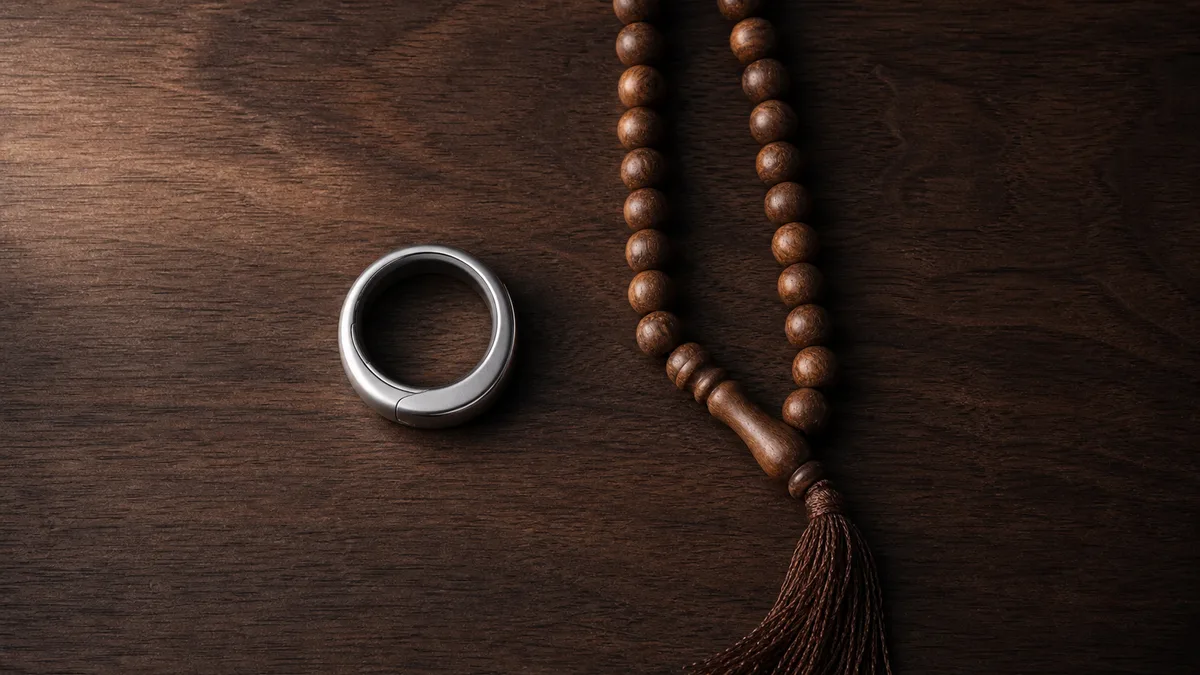
A digital tasbih ring earns its place beside beads on three fronts: it counts hands-free while you cook or queue for iftar; it keeps your place when life interrupts the 33-count pattern of post-prayer dhikr taught in Sahih al-Bukhari 843³; and it syncs your daily total. Beads keep the edge on tactile ritual and zero charging. It complements; it doesn’t replace.
What Ramadan asks | Digital tasbih ring | Manual prayer beads |
|---|---|---|
Hands-free counting | Counts by touch while you carry, cook or drive | Needs a free hand |
Interruption-proof memory | Holds your count when you’re called away | Easy to lose your place |
Tactile ritual | A soft press, nothing more | The slow, familiar pull of beads |
Power | An occasional charge | Never needs one |
Why does the exact count matter at all? Because the counts are precise, not approximate. One traditional pattern recorded in Sahih Muslim 597⁴ completes the hundred with a final tahlil, and the narration attaches forgiveness to it even if sins are like the foam of the sea. When numbers carry that much meaning, a ring that never loses your place is a quiet kindness.
The form of counting has changed shape before. In the early Muslim era, prayers were counted on fingers or with pebbles, as Wikipedia’s Misbaha entry records⁵. Sunan Abi Dawud 1502 describes the Prophet (peace be upon him) counting the glorification of Allah on his fingers, a narration graded sahih by al-Albani⁶.
Later came the misbaha itself: commonly 100 beads for 33 tasbih, 33 tahmid and 34 takbir, with 99-bead and 33-bead forms too, known as subha, tasbih or tespih across Muslim communities. Even the debate over new forms is old. Al-Suyuti, who died in 911 AH (1505 CE), wrote a treatise defending prayer beads, as Egypt’s Dar al-Ifta notes⁷. The shape keeps changing; the dhikr never has. If the permissibility question sits on your mind, we’ve written a calm, thorough answer in are zikr rings halal.
In our experience, the best rings let the two worlds meet: a bead-like quietness on the hand, with a count that keeps itself. That’s the idea our Smart Tasbih Jewelry, the WESLAMIC iTasbih line, is built around.
The Three Tiers of Digital Tasbih Rings (and What the Price Gap Actually Buys)
Digital tasbih rings fall into three honest tiers. As of mid-2026, our survey of listings found white-labels clustered in a $10-25 entry band, most sold without any warranty. The functional 1.0 tier leads on technology yet feels like tech, not jewelry. The designed daily-wear tier adds true sizing, gift packaging and jewelry looks. The gap buys longevity, not extra counting.
Tier 1: the white-label twins. Search any marketplace and you’ll meet the same ring a dozen times under interchangeable storefront names. Same shell, same shared display module, different logo. They’re honest about one thing: price. They do count. But sizing is fixed, warranties are rare, and the companion app, where one exists, has an uncertain future. Fine as a trial. As a month-long companion, they tend to feel like a compromise by the second week.
Tier 2: the functional 1.0. The most established maker in this tier deserves real credit: it proved a counting ring could be smart, and its app runs deep. Public user feedback, though, keeps returning to three trade-offs we score below: daylight readability, connection stability and battery lifespan. The bigger point is the feel: capable, but designed and priced like technology rather than jewelry.
Tier 3: designed daily-wear rings. This is where our own WESLAMIC iTasbih line sits, so read us knowing that; we’ve tried to stay honest about what the extra money buys. iTasbih-Salam is the entry point, and the first thing the gap buys is being taken seriously: real sizing, real support, a ring meant to last past one season.
iTasbih-Faith is the everyday classic that fits almost everyone. iTasbih-Relation adds an elegant metal finish and a light-luxury gift box. And iTasbih-Peace1 goes full-ring: on the hand, it’s simply a clean, modern ring with a quiet second life.
One more thing the gap buys: a future. A ring’s value depends on whether you can keep using it well, through resizing, app updates and support that actually answers. If you’re weighing the learning curve, our guide on how to use zikr ring shows what daily use looks like in practice.
So which tier belongs on your hand? That depends on budget, occasion and taste, and we’ll name picks shortly. First, the screen question everyone asks.
OLED vs LED Displays (and Whether You Even Need a Screen)
Almost every digital tasbih ring uses an OLED display, not LED, so “OLED vs LED” is mostly a mislabel; in mid-2026, nearly every listing we reviewed carried an OLED module, whatever its title claimed. The real Ramadan questions are different. Does the screen stay readable in direct sun? And do you want a screen at all?
The mislabel is harmless marketing shorthand, but it hides the point. OLED is the tiny self-lit screen type used across this category, including the shared module in the white-label tier (see above). It’s crisp indoors and gentle on battery. Its known weakness is direct sunlight, where it can wash out, and that washout is a recurring theme in public reviews of screened rings across this category.
Ramadan makes that weakness personal. You’re outdoors while fasting: school runs, errands, the walk to the masjid. Can you read your count at noon? If glancing at the screen matters to you, test it in daylight while you can still exchange it, not in a dim room on day 28.
Do you actually need a screen to keep count? In our experience, most wearers glance at the total far less than they expect after the first week. The count lives in the app, or simply in the habit. A screenless ring gives up the glance and gains something Ramadan-specific: nothing glows during salah, and nothing on your hand says technology.
That’s the path our iTasbih-Peace1 takes: no visible screen at all, just a clean modern ring that keeps quiet company through wudu and the workday. There’s a whole jewelry side to that choice, and it gets a section of its own below.
How Do the Three Tiers Score Across a Full Ramadan Wear Cycle?
The designed daily-wear tier wins the month. The functional 1.0 tier scores highest on app depth, but it shares the sealed construction that iFixit’s Samsung Galaxy Ring teardown⁸, reported by TechSpot⁹, found isn’t designed to last more than two years (sealed like that, the ring’s lifespan is the battery’s lifespan), and the daylight washout documented above drags it further down. White-label rings win on price alone. Here’s the scorecard.
Ramadan test | White-label tier | Functional 1.0 tier | Designed daily-wear (WESLAMIC iTasbih) |
|---|---|---|---|
All-day comfort | Weak: fixed sizing, light plastic feel | Mixed: wearable, shaped like tech | Strong: true ring sizes |
Daylight readability | Weak: shared display module | Weak: recurring washout reports in direct sun | Mixed-Strong: screened models share OLED’s sun limits; screenless Peace1 sidesteps them |
Charge & battery | Mixed: varies listing to listing | Weak: sealed battery, no swap | Strong: weeks of wear per charge |
Eid-photo looks | Weak: reads as plastic | Mixed: neat, but reads as tech | Strong: designed as jewelry first |
Sizing & fit | Weak: limited fixed sizes | Mixed: standard runs | Strong: sized like a ring should be |
Editorial assessment, mid-2026, drawn from public user feedback and WESLAMIC’s published product specifications.
Does a scorecard overstate things? A ring that merely counts will still count. But Ramadan multiplies small frictions by thirty: a size that pinches, a screen you shade with your palm, a battery warning at tarawih. The tier that removes those frictions is the tier you’ll still be wearing in the final week.
One plain note: public feedback on the 1.0 tier also mentions occasional Bluetooth drops; not fatal, but worth knowing if the app matters to you.
Our finding: Rated by our own product specifications, iTasbih-Salam wears up to 20 days at 500 counts a day from a single charge. For most wearers, that’s one top-up across the entire month.
WESLAMIC iTasbih vs Rival Makers: The Honest Read
Put faces to the tiers and the choice gets simpler. In our mid-2026 survey of listings, storefront white-labels sat squarely in the budget band, the category’s most established maker anchored the technology-led tier with the deepest app, a dressier newcomer courted the middle ground, and WESLAMIC iTasbih was the line built as faith jewelry first. Here’s the honest read on each.
The technology-led pioneer. The most established rival maker in the category is the technology benchmark: a mature app, multiple models, wide availability. The trade-offs are the ones already scored above, in the daylight and battery rows of the scorecard. If app depth matters most to you and jewelry feel least, it’s the serious tech-first choice.
The dressier newcomer. One smaller maker courts the same instinct we design for: a ring that reads as a ring. As of mid-2026, though, we couldn’t verify its long-term durability or after-sales record from independent reviews, and availability runs thinner than the established players’. Worth watching; harder to gift with confidence today.
The storefront white-labels. These are less brands than storefront names, several of which come and go over the same white-label hardware described in Tier 1 above. Nothing about them is dishonest; the price is the whole promise. What you give up is everything around the counting: sizing options, support that answers, an app with a future.
WESLAMIC iTasbih is our own line, so weigh our words accordingly. It’s the only one of the four designed as Smart Tasbih Jewelry from the first sketch: true ring sizing, metal finishes, gift boxes, and a screenless option in Peace1 with no visible technology at all. The scorecard above shows how that plays out across the month.
The short version: if app depth is everything to you, the technology-led pioneer earns its reputation; if you only want the cheapest possible trial, a storefront white-label will count. If you want a ring you’ll still be wearing long after the month ends, that’s the tier we build for.
The Tasbih Ring Aesthetic: Wearing Dhikr, Not a Gadget
A counting ring can absolutely look right in Eid photos, if it was designed as jewelry first. In October 2025, the Consumer Technology Association’s article “Smart Rings Join the Wearables Revolution” described the category as sleek, discreet and always-on¹⁰. On Eid morning, with every hand in the frame, that’s the standard your ring has to meet.
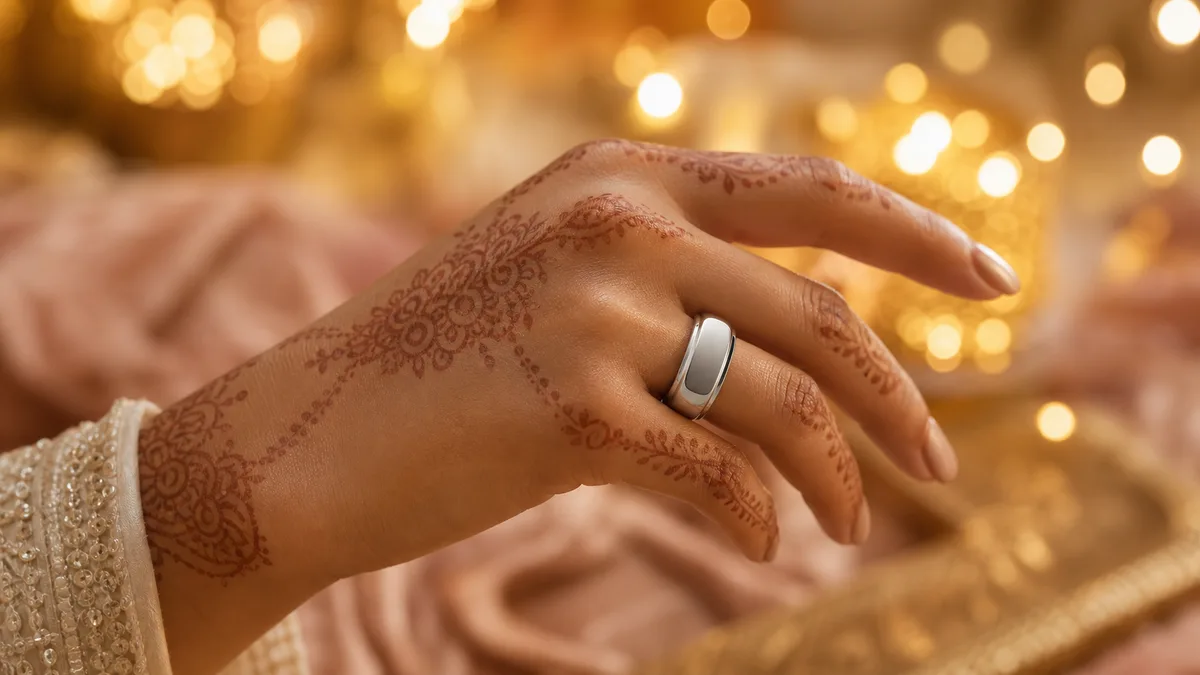
Picture the photos you’ll actually keep: henna, a new outfit, your family crowded into one frame. Anything on your hands is in the shot. A ring that reads as electronics interrupts the picture. One that reads as faith jewelry belongs in it, on Eid and on every ordinary Tuesday after.
This is where screenless, metal-finished designs quietly win; the screen trade-offs above tell the same story from the other side. And it’s where gift-buyers should slow down for one detail. Many of our readers choose rings for husbands, fathers and brothers, and materials carry real rulings for men, gold above all. Our guide on can men wear rings in Islam walks through it before you buy.
We’ve found that the rings people wear all month are the ones they’d wear anyway, dhikr aside. Beauty here isn’t vanity. It’s what keeps the companion on your hand.
Best Digital Tasbih Counter Ring Picks for Ramadan 2027
Ramadan 2027 is expected to begin on the evening of Sunday, February 7, with the first fast on Monday, February 8, and Eid al-Fitr around March 9, per the Human Relief Foundation’s Ramadan 2027 guide¹¹ and Aladhan’s prayer timetable¹², with exact dates confirmed locally by crescent sighting. Whichever ring you choose, leave time to size it, charge it and let it become familiar before the month begins.
If you’re still weighing tiers, the brand-by-brand section above gives the honest trade-offs. The picks below are the rings we’d put on a hand we love.
Best First Ring: iTasbih-Salam
Salam is the simple, affordable way to begin. Dhikr slips naturally into home, work and travel, with no beads to carry and no count to hold in your head. It’s the ring we suggest for new Muslims, and the easiest first Ramadan or Eid gift you can give.
Best Everyday Classic: iTasbih-Faith
Faith is the safe default for almost any Muslim in your life. It makes daily dhikr easier and a little more beautiful, with gentle prayer-time reminders that suggest rather than push. Unsure of taste or size? This is the one that fits almost everyone.
Best Gift Set: iTasbih-Relation
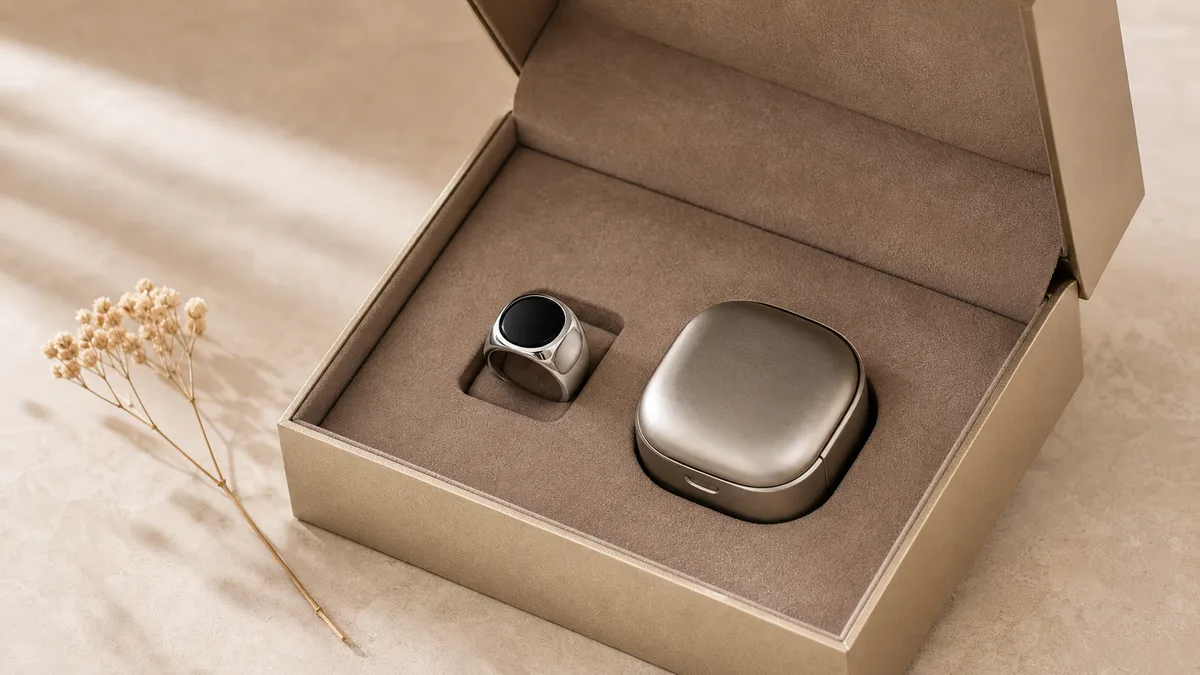
Relation is the piece with presence: an elegant metal finish in a light-luxury gift box, and, with its charging case, up to 33 days of wear. It’s made for weddings, milestone gifts for a spouse or parents, and premium Eid gifting across Muslim communities.
Best Screenless: iTasbih-Peace1
Peace1 looks like a clean modern ring and nothing else. It keeps quiet company around the clock, through wudu and daily life, and it suits design-conscious wear best: a self-gift, or a gift for someone who’d never wear anything that blinks.
Whichever hand you’re buying for, pick the ring that will still feel like yours on day 29. When you’re ready to compare finishes and sizes side by side, See all smart tasbih ring styles in one place.
Frequently Asked Questions
Is it permissible to count dhikr on a ring instead of my fingers?
Scholars have broadly allowed counting aids. IslamQA’s published answer 198080 records Ibn Uthaymeen’s view that such counting aids are permissible¹³, while counting on the fingers remains preferable, in the spirit of Sunan Abi Dawud 1502⁶. We don’t issue fatwa; for your own case, ask a qualified scholar, and see the history section above.
How long will the battery actually last through Ramadan?
Per WESLAMIC’s published product specifications, iTasbih-Faith charges fully in 1.5 hours and wears up to 15 days at around 500 counts a day, with standby up to 30 days. In practice, one or two charges cover the month; plug it in over suhoor and it’s ready before Fajr.
Is a $10-25 white-label ring good enough for one Ramadan?
It counts, and as a low-stakes trial that may be enough. But 29 to 30 consecutive days of wear is unforgiving, and the trade-offs described in the tiers above tend to surface by week two. If the ring is a gift, the risk doubles; you won’t be there when it disappoints.
What count should I set the ring for?
Most people start with post-prayer tasbih: SubhanAllah, Alhamdulillah and Allahu Akbar, 33 times each, as taught in Sahih al-Bukhari 843³. A target of 100 suits the traditional pattern that closes with a final tahlil. Beyond that, set totals that feel kind; let the month lead, not the number.
WESLAMIC shares practice-focused guidance and does not issue fatwa. For personal rulings, please consult a qualified scholar. Reviewed by the WESLAMIC Editorial team.
Sources
⁷ Dar al-Ifta (Egypt), “What is the ruling on using prayer beads (subha)?”, retrieved 2026-07-01
⁸ iFixit, “Samsung’s Galaxy Ring Revealed (teardown)”, retrieved 2026-07-02
¹⁰ Consumer Technology Association, “Smart Rings Join the Wearables Revolution”, retrieved 2026-07-01
¹¹ Human Relief Foundation, “When is Ramadan 2027?”, retrieved 2026-07-02
¹² Aladhan, “Ramadan 2027 Prayer Times (London)”, retrieved 2026-07-02
¹³ IslamQA (islamqa.info), “Ruling on using a tasbih ring”, answer 198080
WESLAMIC, Zikr Ring collection product specifications (first-party product data), retrieved 2026-07-02