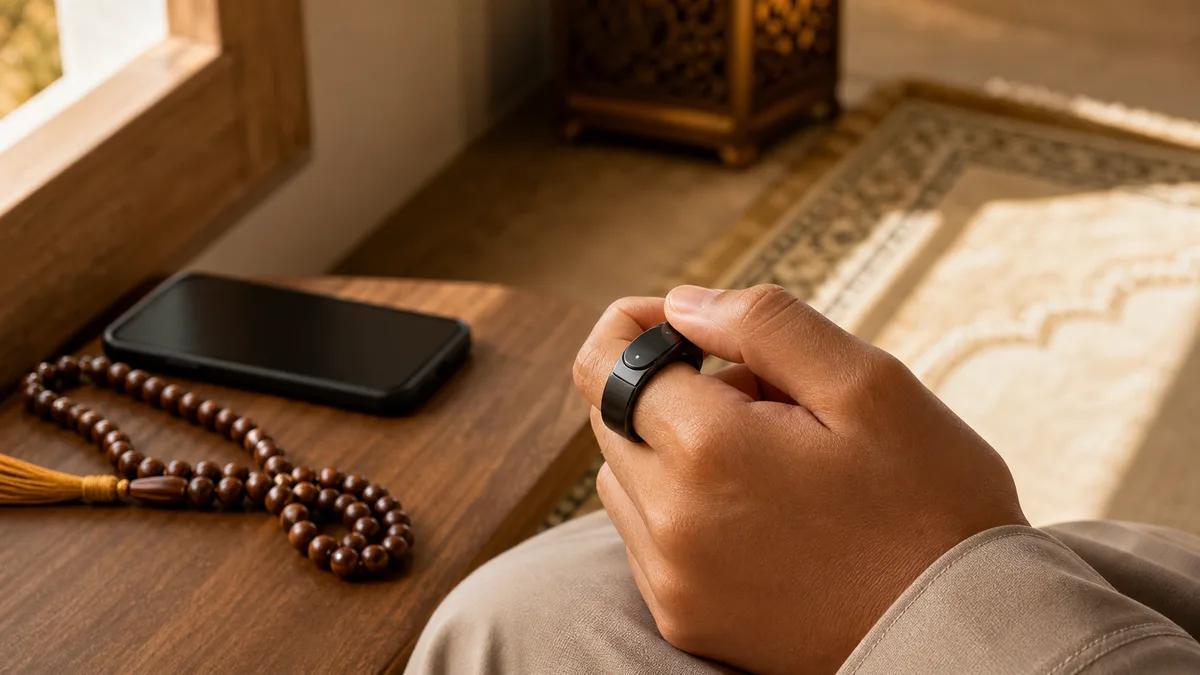
You open the app, tap the screen a dozen times, and a message banner slides down. By the time you’ve swiped it away, the number is gone from your head, and the quiet has gone with it. If you’ve ever counted dhikr on a phone, you know that small loss well.
There’s another way to keep count, and it doesn’t ask for your eyes at all. Below, we compare the two forms a dhikr tracker app can take, explain what the category actually does, share a six-point buying checklist, and show how our app counts through a ring instead of a screen.
Key Takeaways
Most dhikr apps count only while you hold the phone and watch the screen; a ring-paired app counts while the phone stays in your pocket.
In a 2017 Journal of the Association for Consumer Research study of nearly 800 people, a phone merely sitting in view quietly taxed attention.¹
The WESLAMIC App pairs with the full iTasbih family, from the gift-friendly Salam to the health-aware FIT, so one quiet history follows whichever ring suits your day.
Gentle progress, no streaks: good tracking should add calm, not pressure.
Phone App vs. Ring-Paired App: Two Ways to Track Your Dhikr
There are two ways to track dhikr with an app, and they differ in what they ask of you. A phone-only app asks you to watch the screen and tap it; lock the phone or take a notification, and the counting flow breaks. A ring-paired app asks only for your thumb, and the walkthrough below shows exactly how that works.
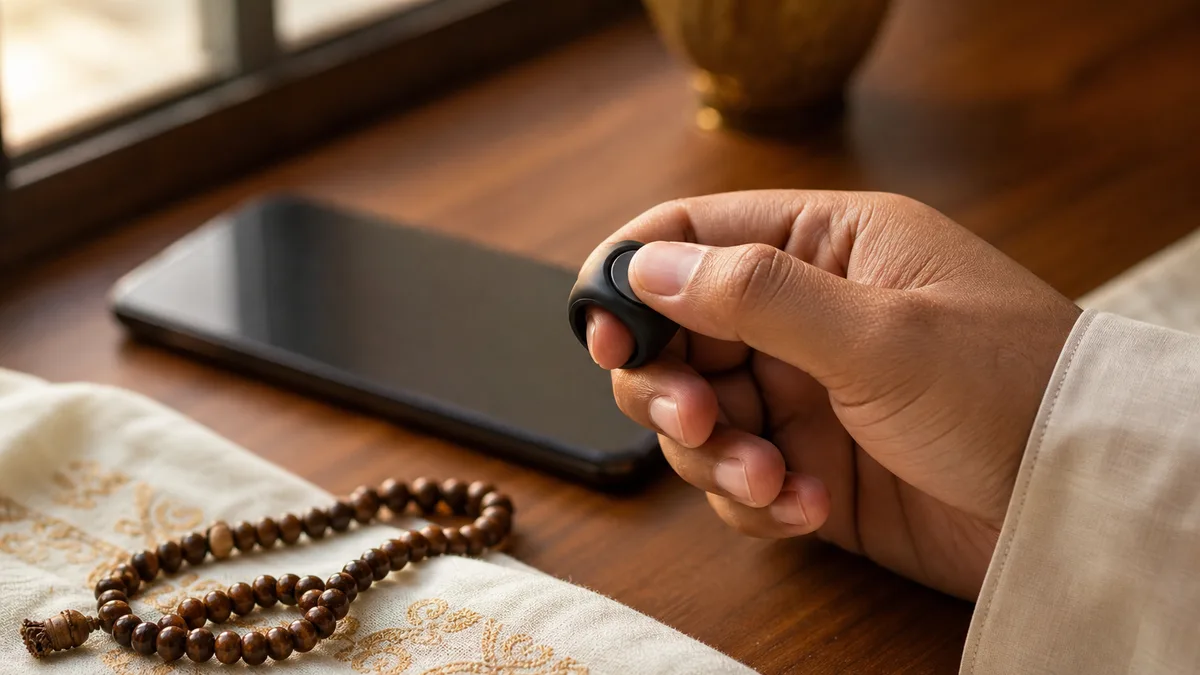
We tried the phone-first route ourselves before building anything. Counting with a phone app meant the screen had to stay on, in hand, and attended. Every banner was an interruption. Every lock-screen timeout meant fishing the phone back out. And our eyes kept settling on the glass instead of the words we were saying. In our experience, the phone didn’t just hold the count; it held the attention too.
There’s research behind that feeling. In 2017, the “Brain Drain” study by Ward, Duke, Gneezy, and Bos in the Journal of the Association for Consumer Research, spanning nearly 800 participants, found that the mere presence of a person’s own smartphone quietly reduced available cognitive capacity.¹ People whose phones sat in another room did better on attention tasks than people whose phones lay silenced, face down, on the desk.
The ring-paired flow is built around that finding, whether or not we knew it at the time. You press the ring once with your thumb, and one dhikr is recorded. The count saves and syncs to the app on its own, where daily and weekly progress waits for whenever you feel like looking. On a full-circle style like the iTasbih-Peace1, what’s on your hand reads as a simple modern ring, not a screen.
Our finding: In our side-by-side trial, the phone app needed eyes, light, and an unlocked screen to log a single dhikr; the ring needed one thumb and nothing else.
Curious how the ring sits and taps day to day? See how to use zikr ring. And which everyday moments each form can actually catch, commutes, queues, the minutes after salah, is mapped in the scenario table further down.
What to Look For in a Dhikr Tracker App
A dhikr tracker app earns its place in five ways: counting each recitation, saving the total, showing progress across days and weeks, sending prayer and dhikr reminders, and syncing so your history follows you. Sahih al-Bukhari 843 records the beloved rhythm of SubhanAllah, Alhamdulillah, and Allahu Akbar, 33 times each after every prayer², and an app’s whole job is to hold counts like these so you don’t have to.
How is that different from what you already own? Prayer beads are beautiful, but they keep no history; yesterday’s dhikr lives only in your memory. A simple pocket clicker forgets the moment you reset it. An app remembers for you, which is its one honest advantage.
So how do you judge a particular app? Choose by six things: whether counts survive a locked screen, whether you can count without looking at the phone, offline behavior and data appetite, prayer and dhikr reminders, sync with progress you can actually see, and whether it leans on streaks to keep you engaged. The two criteria most dhikr apps miss are screen-free counting and guilt-free tracking; test both before you trust months of dhikr to one app.
Counts that survive a locked screen. Quick test: count to ten, lock the phone for a minute, reopen. If the session reset, you’ve learned everything you need. Why this matters so much is covered in the comparison above.
A way to count without looking at the phone. How ring input compares with screen input is mapped in the comparison above. There’s a quiet fittingness to it, too: Sunan Abi Dawud 1502 relates that the Prophet ﷺ counted the glorification of Allah on his fingers³, and a ring lives exactly where that counting has always lived. Scholars have long discussed counting aids, from IslamQA’s answer on tasbih rings, which cites Ibn Uthaymeen⁴, to classical discussions of the subha; positions vary in emphasis, and we don’t issue rulings. For the fuller picture, see are zikr rings halal.
Offline behavior and data appetite. Can it count with no connection, and what does it ask to know about you? One glance at the permissions list tells you a lot; we go deeper in the privacy section below.
Prayer and dhikr reminders. A tracker that also knows your prayer times folds naturally into the day instead of sitting apart from it.
Sync and visible progress. Weeks of dhikr should be somewhere you can quietly revisit, not trapped on one phone.
Gentle progress, not streak pressure. Some apps push engagement mechanics borrowed from games. Whether that suits dhikr at all is a question we take up properly below.
The WESLAMIC App: A Dhikr Tracker That Counts Through Your Ring
The WESLAMIC App is free; as of July 2026, its official Apple App Store listing carries no price at all.⁵ The counting mechanics are the ones described in the comparison above, the ring takes the taps and the app keeps the record, so what’s left to cover is everything the app adds around that record.
Here’s the shape of the partnership. The ring gathers your taps through the day, and your history quietly fills in whenever the two meet, exactly as described above. The app’s own gifts are the things a ring can’t hold: Azan alerts for the five daily prayers wherever you are, customizable dhikr reminders, a Daily Dhikr list for words worth repeating, and a Dhikr Together space for counting in company. With the iTasbih-FIT, it also keeps a gentle Fajr record alongside sleep and heart rate.
Which ring, then? That depends on who it’s for.
iTasbih-Salam is the lightest first step: simple, warm, and priced for giving. A lovely first gift for a friend or someone new to the deen.
iTasbih-Faith is the classic daily companion, with a gentle prayer-time vibration and five interchangeable sizes. It’s the one we’d hand to parents, and the one many of us wear ourselves.
iTasbih-Peace1 is the full-circle piece that reads as a simple modern ring, as noted above. Light, water resistant, and easy to wear around the clock; made for anyone who wants their faith worn quietly.
iTasbih-FIT joins faith and health in one band: sleep, heart rate, and that morning Fajr rhythm. One honest note: the current FIT has no vibration motor, so prayer reminders come from the app rather than your finger.
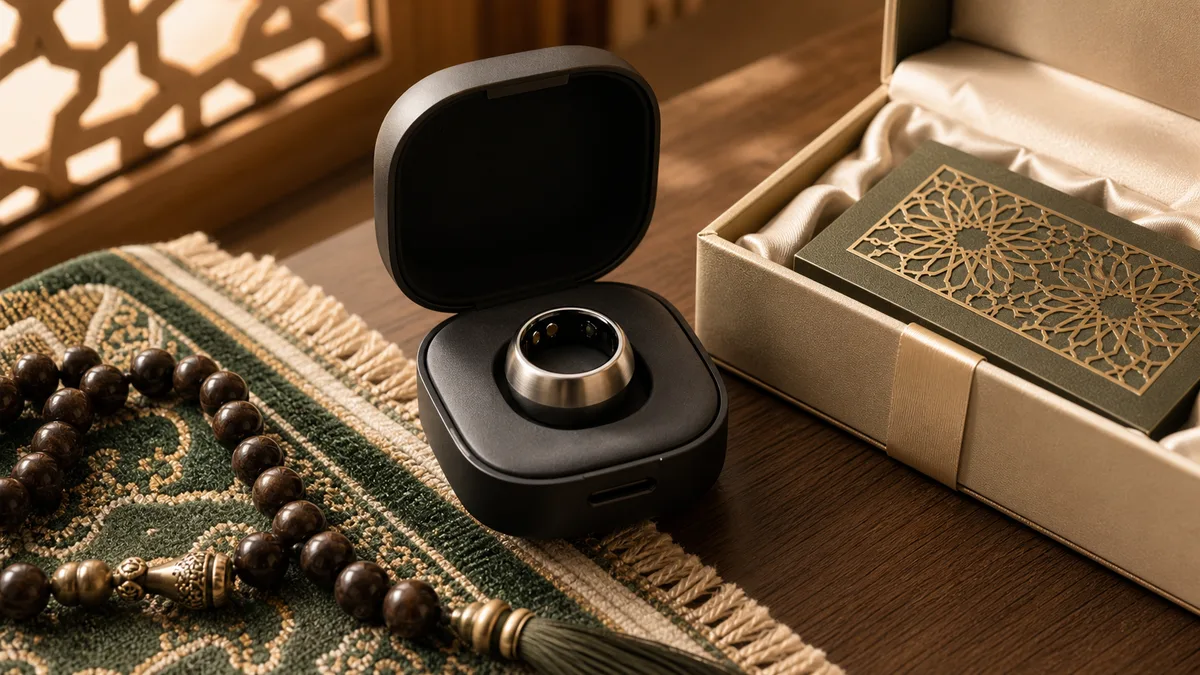
iTasbih-Relation is the gift-ready choice: refined metal in a boxed set with its own charging case, made for weddings, anniversaries, and thank-yous. Its battery story gets its own moment in the privacy section below.
The app is the doorway; the ring is the companion. Like the whole family side by side? See all smart tasbih ring models on one page. And if you’re wondering why none of this involves streaks or badges, that’s not an oversight. It’s the next section.
Tracking Without the Guilt: Presence Over Counting
Dhikr is not a KPI, and tracking it should never feel like a task you failed. A good tracker leaves you calmer, not staring at a broken streak. Our principle is presence over counting: the ring counts for you, so your attention stays with the remembrance rather than the number.
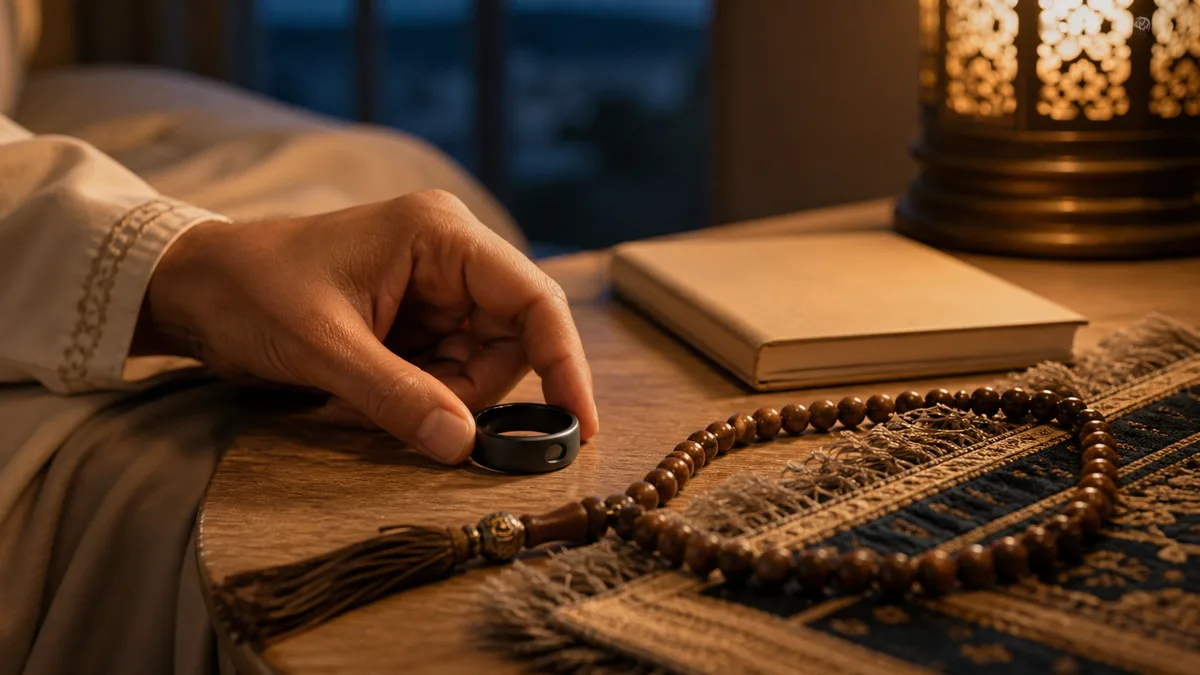
Much of the habit-app world runs on the opposite fuel. Streak flames, badges, a red banner saying you missed yesterday. Does borrowed game design belong anywhere near remembrance? In 2023, Silverman and Barasch’s paper “On or Off Track: How (Broken) Streaks Affect Consumer Decisions,” published in the Journal of Consumer Research across seven studies, found that highlighting a broken streak demotivates people and reduces the very engagement it was meant to protect.⁶ The mechanic doesn’t just feel wrong; it often backfires.
So we build the other way. Every Dhikr Matters is the whole of our philosophy: each small remembrance counts, and none should arrive wrapped in a debt. In the WESLAMIC App, your history is a quiet record you can visit or ignore. No flame to keep alive. No notification doing arithmetic on your absence. If a week goes quiet, the ring simply waits, and the first tap back is received like every other.
That’s also why the counting piece is jewelry rather than another glowing rectangle. We make faith jewelry because a companion should be something you’d wear for its own sake, something that happens to remember your numbers for you. The count is the servant here. The presence is the point.
Do You Really Need an App to Track Dhikr?
Honestly, no. Fingers and beads have carried dhikr for fourteen centuries without a single sync. An app earns its place only for what memory can’t do alone: keeping weeks of history, showing gentle progress, and reminding you when prayer time approaches. A ring-paired app adds one more thing, catching the dhikr that happens when your phone isn’t in your hand.
And that’s most of it. The Quran describes the people of remembrance this way, in Surah Al ‘Imran 3:191 as rendered on Quran.com: “˹They are˺ those who remember Allah while standing, sitting, and lying on their sides.”⁷ Remembrance belongs to ordinary postures and in-between moments, which are exactly the moments a screen-bound app is worst placed to reach.
We mapped a normal day against both forms, and the gap is structural, not stylistic:
Where dhikr actually happens | Phone-only app | Ring-paired app |
|---|---|---|
Commuting, hands full | Phone buried in a bag; counting waits | Thumb finds the ring; every rep lands |
After salah (the 33-33-33 of Sahih al-Bukhari 843) | Unlock, find the app, begin | Tap through it without breaking the stillness |
Walking between errands | Eyes down on a bright screen | Eyes up, count riding on your finger |
Waiting in a queue | Works, until a banner arrives | Quiet taps, nothing to watch |
Lying down before sleep | Screen light in a dark room | The room stays dark |
The table maps where each form can receive a count; it says nothing about the worth of the dhikr itself, which needs no hardware at all.
If your practice is short, settled, and happy on beads, you truly don’t need any of this. If you want memory, reminders, and a rhythm that survives busy seasons, an app helps, and a ring-paired one reaches the moments above. Wondering about a ring on a man’s hand? That question has its own careful page: can men wear rings in Islam. And for the practical wearing rhythm itself, see how to use zikr ring.
Privacy, Offline Access, and Battery Life
Before trusting any faith app long-term, ask three things: can it count and show your history offline, what data does it request and why, and how much charging it adds to your week. On our rings, the answer to the last one is measured in weeks, not days; the iTasbih-Relation’s charging-case set carries up to 33 days between wall charges.
Privacy first. A prayer-time app has one legitimate reason to know your location: calculating the five daily times where you actually are. Anything beyond that deserves a raised eyebrow, so read the permissions list before installing anything, ours included. The WESLAMIC App is free because the rings carry the business; the app doesn’t have to earn its keep by selling your attention.
Offline, the ring is the quiet hero. It keeps its own tally between syncs, the same partnership described above, so a dead zone or a phone left at home costs you nothing. The count doesn’t depend on a signal. It depends on your thumb.
Battery is where jewelry beats screens outright. These rings sip power rather than drink it: the Relation’s case-and-ring set reaches that 33-day figure above, and the lightest rings in the range are built for round-the-clock wear, water resistance included. Heading into 2027, our aim stays the same: charging so rare you forget it’s a thing the ring asks of you.
That’s the whole picture, from what a dhikr tracker app is to which one respects your quiet. When you’re ready to choose the hand-worn half: See all smart tasbih ring models in one place.
Frequently Asked Questions
Can I use the WESLAMIC App without an iTasbih ring?
Yes. On its own, the app gives you Azan alerts at the 5 daily prayer times, the Daily Dhikr list, and the Dhikr Together space. The ring simply adds screen-free counting on top.
Does tracking dhikr with an app defeat its purpose?
Not if the tracking serves the remembrance rather than replacing it. Sunan Abi Dawud 1502 relates the Prophet ﷺ counted glorification on his fingers³, so keeping count is itself a sunnah-rooted practice. What we’d avoid is score-chasing; see the presence-over-counting section above. For rulings, please ask a qualified scholar.
Which iTasbih ring makes the best gift?
Match the ring to the person. Salam suits a friend’s first step; Faith, with its five interchangeable sizes, fits parents and elders almost by default; Relation arrives gift-boxed for weddings and anniversaries; Peace1 flatters anyone who wants faith worn quietly. All pair with the same app in minutes.
Will I lose counts if my phone is off or somewhere else?
No. The ring stores every tap in its own memory and hands the backlog over at the next connection, so weeks can pass between syncs without a single rep going missing. Nothing about the counting needs your phone nearby, awake, or even in the same building.
Reviewed by the WESLAMIC Editorial team. WESLAMIC does not issue religious rulings; for questions of worship and practice, please consult a qualified scholar.