
Picture a night-shift nurse a little before Fajr in Ramadan. She peels off her gloves, and the ring on her finger has already been quietly counting the dhikr she whispered between rounds. That same ring also noticed how little she slept. Two lives, worship and wellbeing, resting on one hand. That’s the idea this page unpacks.
Key Takeaways
One ring counts dhikr and tracks your health: the WESLAMIC iTasbih-FIT (Smart Tasbih 3.5).
Its Fajr Tracker is a gentle dawn-prayer check-in you confirm in the app.
Smart-ring shipments were set to outpace smartwatches in 2025, up 49% (IDC via Bloomberg).
No motor here. So prayer-time reminders live in the WESLAMIC App or a sibling ring, not as a buzz on your finger.
What a Smart Tasbih Ring With a Heart Rate Monitor Actually Does
A smart tasbih ring with heart rate monitor built in does two jobs on one hand: it keeps your dhikr count and reads your body. The WESLAMIC iTasbih-FIT (Smart Tasbih 3.5) records heart rate, blood oxygen (SpO2), sleep, and daily steps, then syncs both streams, dhikr counts and health data alike, into the WESLAMIC App. So what does that give you day to day?
This page is about that one ring: the iTasbih-FIT. WESLAMIC built it on a simple promise, faith life and health life in a single ring, so you’re not choosing between the two. Think of it as a companion, not a fitness tracker with dhikr bolted on.
Our earlier Smart Tasbih rings (the 2.0 and 3.0 generations) count your dhikr; the 3.5 generation iTasbih-FIT also reads your body. If you want to see how the whole family lines up, our See all smart tasbih ring page walks the range from entry-level to premium.
Here’s the heart of it: the ring notices your worship and your health at once, and it also keeps a note of something that isn’t a health number at all. That’s the Fajr Tracker, which we come to later.
Every Health Metric, Explained: Heart Rate, SpO2, Sleep & Steps
Four health metrics, all on the iTasbih-FIT. Heart rate shows how hard your body is working at rest and on the move; SpO2 estimates blood-oxygen saturation; the sleep tracker logs how long and how well you slept; the step tracker records daily movement. All four feed the WESLAMIC App, building one combined faith-and-health record.

Heart rate. Your pulse climbs when you move and settles when you rest. A calmer resting reading is a soft sign your body is recovering well, say after a long fasting day or a late night of dhikr. For general awareness, the ring estimates this. That’s not a diagnosis, and we’d never pretend otherwise.
SpO2. This estimates the oxygen saturation in your blood. Treat it as a rough wellbeing check, not a medical reading. If you travel at altitude for Hajj or Umrah, it’s a gentle data point to notice. For anything that worries you, see a clinician rather than reading the number as a verdict.
Sleep. Sleep tracking shows how long and how well you slept. It won’t grade you or nag you. It simply surfaces your rest so rough nights stop being invisible. Because sleep and SpO2 both need all-night wear, only a ring that feels like faith jewelry, not a clinical clip on your finger, actually stays on until morning.
Steps. Step tracking records your daily movement. A short walk between Dhuhr and Asr, or pacing while you make dhikr, all of it adds up. Steps here aren’t a performance target. They’re a quiet nudge to keep moving the body God entrusted to you.
Four lines, one record. In our experience, that single record is the point: your dhikr and the tracking side land together in the WESLAMIC App, so nothing lives in a separate silo. We’ll come back to why that matters for worship in a moment.
Faith Mode + Fit Mode: How the Dual-Mode Ring Works
Two modes, one ring. In Faith Mode, it counts your dhikr with a tap. In Fit Mode, it runs its health sensors in the background. Both streams feed the WESLAMIC App, so worship and wellbeing sit in one place, with no separate tasbih or fitness band to juggle.
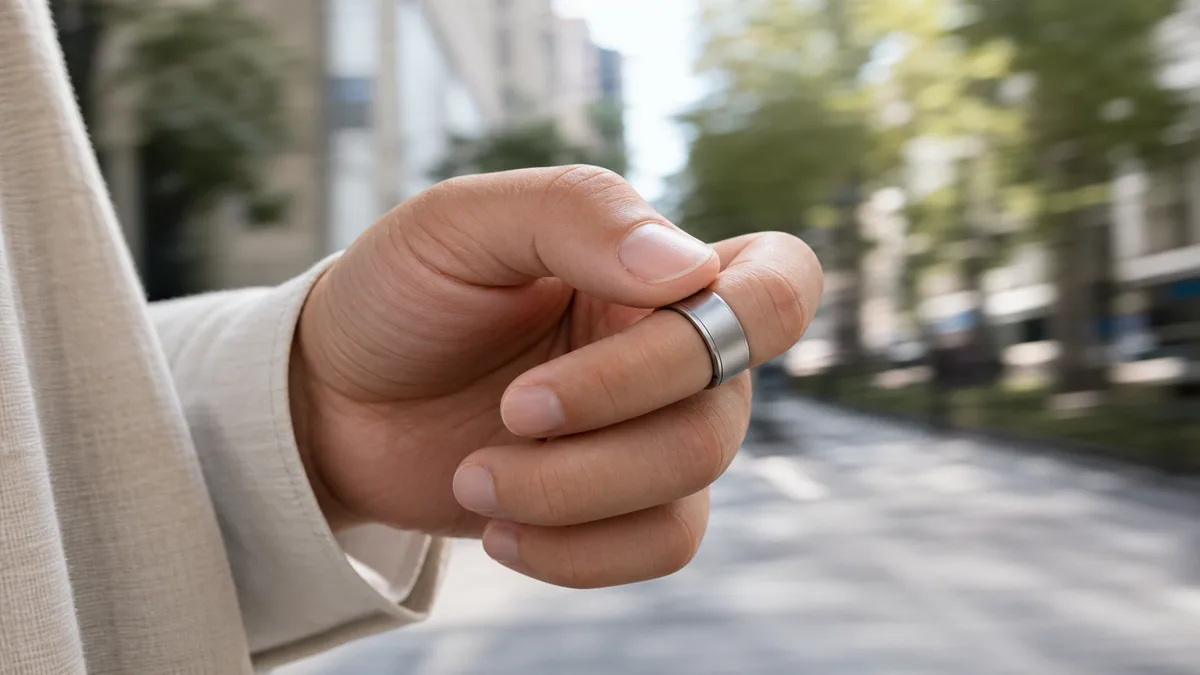
You don’t need to stare at it to tally tasbih. A light tap moves the count while your eyes stay closed. If you want the full walkthrough of counting and resetting, our how to use zikr ring guide covers it step by step, so we won’t repeat the mechanics here.
Could one small ring really keep both streams straight? Yes. They don’t fight for the same job, so nothing collides. In the app, your dhikr history sits beside your health record. Your tracking side never lights up over your count, and your count never blocks the sensors. Worship on one page, wellbeing on the next, both from the same iTasbih-FIT on your finger.
The Fajr Tracker: Where Health Data Serves Worship
Meet the Fajr Tracker, the heart of the iTasbih-FIT. It works as a simple dawn check-in you confirm in the WESLAMIC App, so marking whether you rose and prayed stays in your hands. A 2017 Pew Research Center survey found only 42% of US Muslims pray all five daily prayers¹, and Fajr is often the hardest to hold. This is where the health side starts to serve worship, not the other way around.

In Islam, the body is often taught as an amanah, a trust to care for rather than a project to optimize. So your rest, your pulse, your daily movement aren’t vanity metrics. They’re small ways of stewarding the body so it can stand in prayer. We state the ethic gently and leave any ruling to your local scholar. If you’re wondering whether counting aids like this even fit the sunnah, most contemporary scholars treat them as permissible; our are zikr rings halal page walks through the reasoning.
Here’s the honest part: the ring doesn’t read your sleep to decide whether you woke. Sleep monitoring and the Fajr check-in simply sit side by side in the app, and the brand positions sleep tracking as especially useful if you’re building a steadier dawn habit. We keep the tone soft on purpose. A 2023 Journal of Consumer Research study by Silverman and Barasch found that highlighting a broken streak can actually demotivate people². So the Fajr Tracker stays a gentle mirror, never a scoreboard.
How It Compares: Faith-First Health vs Secular Smart Rings
Faith-first is the whole difference. Fortune Business Insights put the broader smart-ring market at roughly $518.9 million in its 2026 forecast³, and mainstream rings like Oura and the Samsung Galaxy Ring track the same biometrics with no faith layer at all. Only the iTasbih-FIT ties those signals back to worship.
Shipments tell the same story: per IDC data via Bloomberg, smart rings were on track to grow 49% in 2025 against just 6% for smartwatches⁴, and the momentum isn’t slowing heading into 2027. Yet almost all of that growth optimizes sleep and fitness as ends in themselves. Samsung’s Galaxy Ring, for one, launched at $399.99⁵ and reads your body beautifully, but it never asks whether you rose for Fajr.
Even other faith-tech rings that add step or heart-rate sensors tend to frame them as pure tech utility. None of them make the dawn prayer the point. So why pay for the faith layer? Because it changes what the numbers are for.
At a glance, the three rings compare like this:
Ring | Faith layer (Fajr Tracker) | Health signals tracked | On-finger prayer reminder | Subscription | Price |
|---|---|---|---|---|---|
iTasbih-FIT | Yes (built around it) | Heart rate, SpO2, sleep, steps | No (no vibration motor) | None; free WESLAMIC App | $90 |
Oura Ring (Gen 4) | None | Heart rate, HRV, SpO2, temperature, sleep, activity (30+ signals) | None | Required, $5.99/mo | From $349 |
Samsung Galaxy Ring | None | Heart rate, SpO2, skin temperature, sleep and activity | None | None | $399.99 (at launch) |
The sensors are close to a wash. Oura and Samsung track as much as the FIT, sometimes more. The real gap sits elsewhere: only the FIT carries the faith layer, and it’s the cheapest of the three, with no monthly fee to unlock the basics. (Figures for Oura⁶ and Samsung are those brands’ own published numbers, not WESLAMIC quotes.)
Our finding: Line the iTasbih-FIT up beside secular trackers like Oura and the Samsung Galaxy Ring, and one gap stands out. It’s the only ring in our comparison that turns a rough night’s sleep into a reason to protect Fajr, instead of a lower fitness score to fix.
The One Trade-Off: No Vibration Motor, No Prayer-Time Reminder
One honest trade-off, up front. With no vibration motor, the iTasbih-FIT can’t buzz your finger at prayer times. But the WESLAMIC App still carries azan reminders and runs the Fajr Tracker, so you’re not left without a nudge. Two other rings in the line keep the on-finger buzz.
We’d rather say this plainly than bury it in a spec sheet. If a gentle buzz on the finger for Salah is the feature you’d miss most, the iTasbih-Peace1 or the iTasbih-Faith both keep an on-finger vibration cue. In exchange, the FIT trades that motor for its health-sensor package. Neither path is wrong; they’re just built for different habits. One person wants the hands-free reminder, another wants the sleep and heart data. Knowing which one you are makes the choice easy.
Who the iTasbih-FIT Is For (and Who Should Choose Another Model)
Choose the iTasbih-FIT if you want one ring for both dhikr and daily health, and if a steadier Fajr habit matters more to you than a buzz reminder. Sized US 8 to 13, it suits men and women alike. If prayer-time alerts come first, another model in the line will serve you better.
Since it’s a ring, some brothers ask whether wearing one is even allowed at all. That question gets its own full treatment: the can men wear rings in Islam guide walks through the sunnah on silver rings for men.
If a single ring that carries both your worship and your wellbeing sounds right, that’s exactly what the iTasbih-FIT was built for. Want the details? You can see the full specs and finishes on the iTasbih-FIT product page. And if a finger buzz for each Salah is your must-have, the trade-off section above points to the right pick. Every dhikr matters, whether you count it in silence or measure the sleep that helps you rise for the next one.
Frequently Asked Questions
Is the iTasbih-FIT’s SpO2 reading medical-grade?
No. SpO2 is one of four wellbeing signals the ring estimates, for general awareness only, not diagnosis. It isn’t medical-grade. If a reading worries you, see a qualified clinician rather than acting on the number by itself. Think of it as a gentle prompt, not a verdict on your health.
Where do my dhikr and health data actually live?
Both sync to the WESLAMIC App, so your dhikr history and health record open on one screen instead of two apps. Your Fajr check-in insights sit beside your sleep record, too. That companion app is listed at no cost on both stores, free to download on iOS⁷ and Android⁸, so setup costs you nothing.
Does the iTasbih-FIT remind me when it’s time to pray?
Not with a buzz on the finger. This model has no vibration motor. The WESLAMIC App covers those prayer-time reminders instead. Two other rings, the Peace1 and Faith, keep an on-finger cue if that reminder is your priority (see the trade-off section above).
iTasbih-FIT vs Peace1 or Faith: which should I pick?
Pick the FIT for health tracking plus a Fajr habit; pick the Peace1 or Faith for an on-ring prayer buzz. Sizing runs US 8 to 13. There’s no single best ring, only the one that fits your habit, so see the who-it’s-for section above for the full decision.
Does tracking my body with a ring fit my faith?
Many scholars frame caring for the body as an amanah, a trust worth keeping. Most contemporary scholars also treat dhikr counting aids as permissible. Short answer: it can. In WESLAMIC’s five-ring lineup, the iTasbih-FIT is the 3.5 generation. Still, this isn’t a fatwa, so confirm any ruling with your local scholar rather than a web page (see above).
Reviewed by the WESLAMIC Editorial team. Consider this general information for a broad audience, not a fatwa and not medical advice. Health readings from the iTasbih-FIT are estimates meant for wellbeing awareness, not a clinical diagnosis of any kind. Got a religious question? Ask a qualified local scholar. Worried about your health? See a clinician.
Sources
⁵ Android Police, “Samsung Galaxy Ring” (launch price $399.99), retrieved 2026-07-16
⁶ Oura, official Oura Ring (Gen 4) product and Oura Membership pricing, retrieved 2026-07-16
WESLAMIC, iTasbih-FIT product page and first-party product specifications, retrieved 2026-07-16