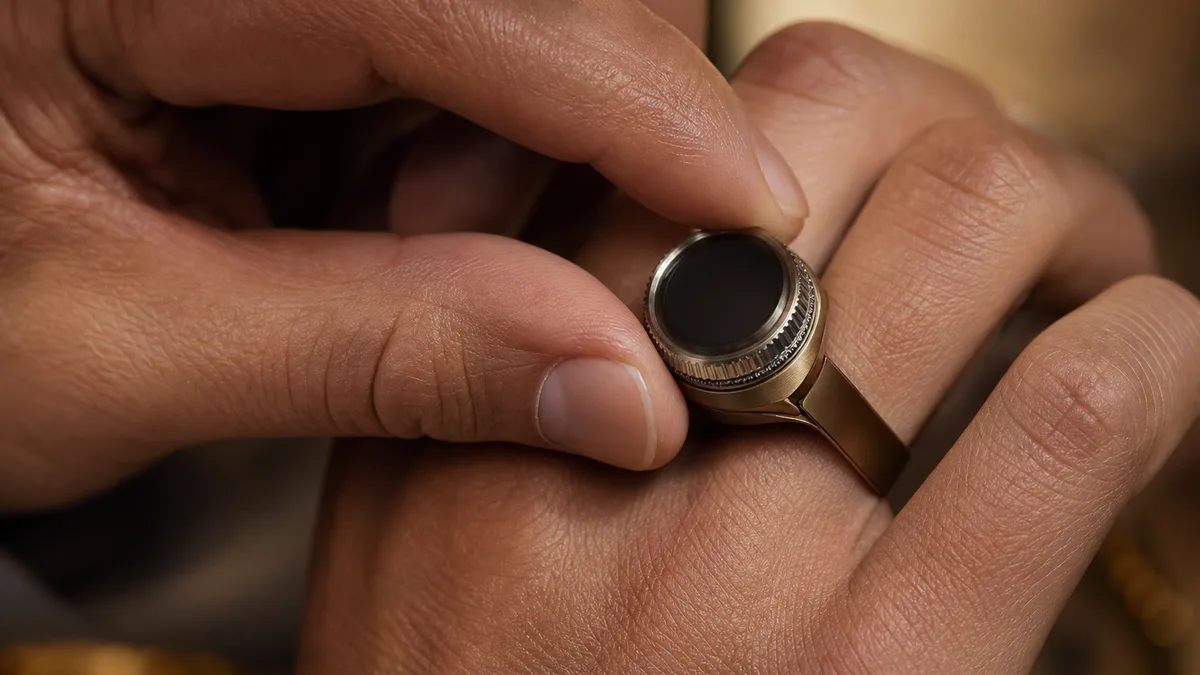
Search “zikr ring qibla direction” and one assumption shows up again and again: that the ring itself is a tiny compass on your finger, quietly pointing to Mecca. Not so. As of 2026, a leading smart ring on the market carries only three sensor types, and no compass among them. So where does qibla actually come from? This page maps exactly which part does what.
Key Takeaways
No mainstream zikr ring hides a qibla compass. As of 2026, a leading smart ring ships just three sensor types, none a compass.
Qibla comes from the paired Weslamic App, which reads your phone’s GPS and magnetometer, then auto-corrects magnetic declination so raw compass error never reaches the on-screen arrow.
Prayer-time buzz lives on the Faith, Relation, and Peace1 models, while the health-focused FIT finds qibla but has no vibration motor.
Does a Zikr Ring Have a Built-In Qibla Compass?
No, no mainstream zikr ring hides a qibla compass inside its band. As of 2026, a leading smart ring on the market carries only three sensor types, an accelerometer, an optical heart-rate sensor, and a skin-temperature sensor¹, and no compass at all. Qibla always comes from the paired app.
Here’s the twist most product pages skip: size isn’t the real blocker. Magnetometers inside phones are cheap MEMS chips, small enough to sit on a single circuit². So why not drop one in a ring? Because a metal band, spinning on a finger all day, is a poor home for a steady compass. Nearby metal skews the reading.
There’s a budget reason too. Rings have a tiny power and space allowance, so makers spend it on what a finger sensor does well: counting, plus health tracking on some models. Adding a compass would drain that budget for a shaky result. That’s why you’ll see some rival listings imply the ring itself points to Mecca, when the direction is really coming from their app.
So it helps to frame your WESLAMIC ring for what it is: quiet faith jewelry you already like wearing, with the pointing handed to the paired Weslamic App. What it adds is a soft pulse at each salah time, a gentle tap that says pause and pray. You’ll find the full hardware-versus-app breakdown two sections below.
How Qibla Direction Actually Works on a Smart Tasbih Ring Setup
Qibla works through a three-part chain, not the ring alone. Your phone’s GPS fixes where you are, its magnetometer reads magnetic north, and the Weslamic App calculates the great-circle bearing to the Kaaba at 21.4225 N, 39.8262 E³, then draws an on-screen arrow. All the ring does is start the prayer-time pulse.
Take it one link at a time. GPS comes first: satellites fix your latitude and longitude, the raw “where am I” every qibla calculation needs. Then the magnetometer reads magnetic north, swinging the way a compass needle does. But magnetic north isn’t true north. That gap matters.
That gap has a name, magnetic declination, and it can reach about 20 degrees depending on where you stand⁴. Good qibla apps correct it for you, leaning on a world magnetic model, the reference NOAA maintains. So the arrow trues up before you ever see it.
Third, the math. Qibla is the initial great-circle bearing from your spot to the Kaaba, the same shortest-path geometry pilots use for flight routes⁵. That’s why it looks odd on a flat map: from many northern cities the bearing points northeast, not straight at the map’s Mecca. Some methods use a rhumb line instead, a different but valid path.
Notice what the ring does to the math here: nothing at all. Sitting at the front, it fires one quiet pulse when a prayer window opens, and that’s its whole job in this chain. Location fix, bearing, arrow? All of it lives in the Weslamic App. We map the full split next.
Hardware vs App: What the Ring Does and What the App Does
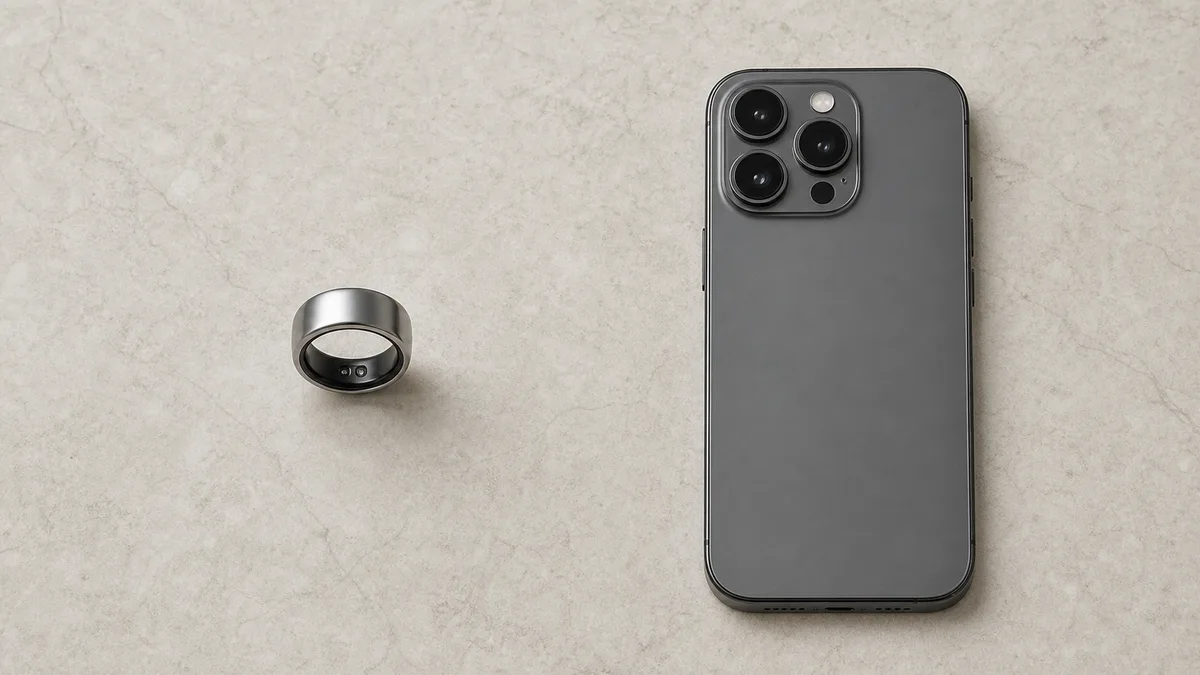
On-ring jobs stay on the ring: dhikr counting, plus the prayer-time buzz on models with a motor. Everything location-based? That belongs to the companion app: the qibla finder, prayer-time calculation, and dhikr-history sync. In our 2026 product matrix, all three location features run entirely app-side, never inside the ring.
Capability | Lives on the ring | Lives in the Weslamic App |
|---|---|---|
Qibla finder | No | Yes, app only |
Prayer-time calculation | No | Yes, from your GPS location |
Prayer-time vibration nudge | Yes, on Faith, Relation, Peace1 (not FIT) | App sends the trigger |
Dhikr counting | Yes, on-ring | Syncs a copy |
Dhikr-history and progress | No | Yes |
Health tracking (heart rate, SpO2, sleep, steps) | Yes, FIT sensors only | Yes, view and trends |
Rule of thumb: anything location-based lives in the app, anything on-the-finger and tactile lives in the ring. That single split is what rival makers tend to blur, leaving buyers unsure which piece finds Mecca.
Why does this matter for qibla? Because if you assume the ring points the way, you’ll blame the ring when the arrow drifts. This is a phone-sensor job. Knowing the split saves you troubleshooting the wrong thing, which the troubleshooting section covers further down.
Which ring carries that tactile cue, and which trades it for health tracking, is exactly the buying question the next section settles.
Which WESLAMIC Rings Support the Full Qibla & Prayer Workflow
Every WESLAMIC ring gets qibla the same way, through the app, so the deciding factor is the prayer-time cue. Three of our four current models carry the vibration motor, iTasbih-Faith, iTasbih-Relation, and iTasbih-Peace1, per our 2026 product matrix, so the full qibla-plus-nudge workflow runs on those three. That fourth model, the FIT, finds qibla but skips the on-ring buzz.
If you want the prayer-time tap on your finger, any of the three vibration models fits. iTasbih-Faith is the everyday classic, a gentle daily companion that buzzes softly at each salah. iTasbih-Relation adds a metal-plated finish and long battery life for a more giftable feel, while the full-ring iTasbih-Peace1 is built to be worn around the clock, so the cue reaches you whether you’re at your desk or already making wudu.
iTasbih-FIT is the exception here. Instead of a buzz, it packs health sensors, heart rate, SpO2, sleep, and steps, so it tracks your wellbeing and still finds qibla through the app, but it won’t tap your finger when a prayer time opens. Either way, qibla stays app-side for every model, as the hardware-versus-app split above lays out.
To match a model to the way you pray, See all smart tasbih ring and weigh the three vibration pieces against the health-focused FIT.
How to Find Qibla Using the Weslamic App (Step by Step)
To find qibla, open the Weslamic App, grant location permission, tap the Qibla tab, lay the phone flat, and turn until the arrow locks onto the Kaaba marker. As noted above, the app handles that correction for you, so the arrow points the real way. Your paired ring nudges you each prayer time.
Open the app and allow location. Qibla won’t load without your position, so tap Allow when the permission prompt appears. No location, no arrow.
Tap the Qibla tab. You’ll see a compass face marked with the Kaaba. Lay the phone flat on your palm or a table, screen up, and hold it roughly level so the reading settles.
Turn your body, not just the phone. Rotate slowly until the arrow meets the Kaaba marker. That heading is your qibla.
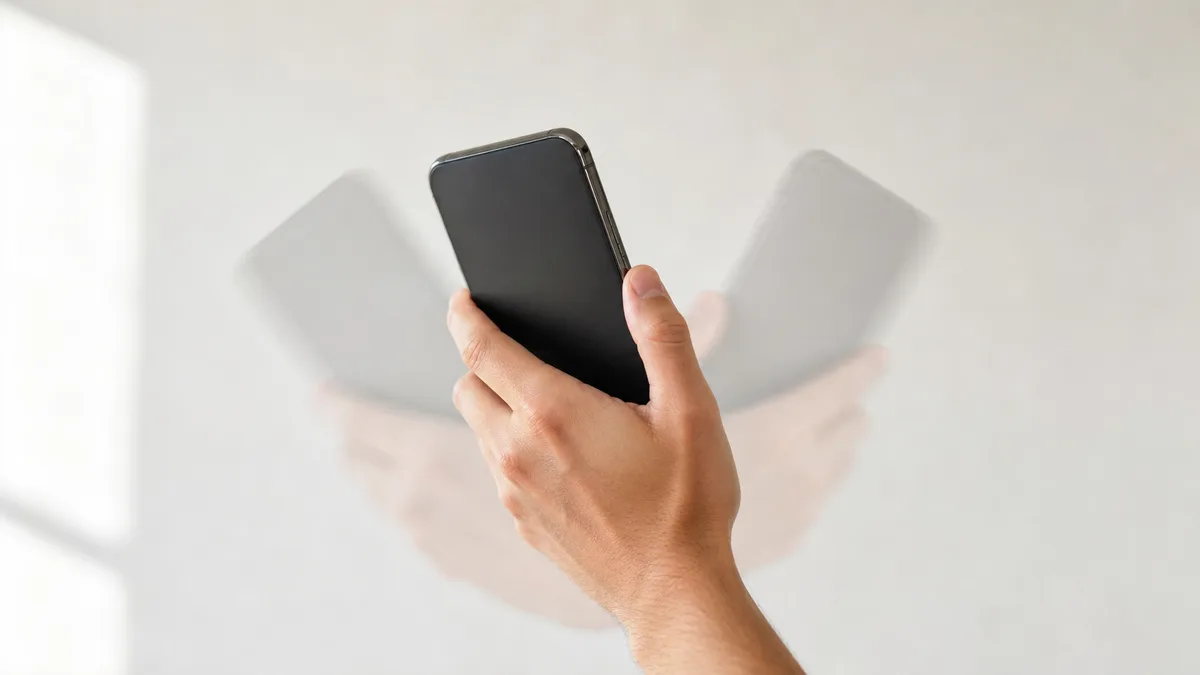
Calibrate if the needle wanders. Trace a figure-eight in the air with your wrist a few times to reset the magnetometer.
Pray, and let the ring keep time. Facing the qibla, your paired ring, say a daily iTasbih-Faith, takes over, buzzing softly when the next salah is due.
One more tip from our own testing: give GPS a moment outdoors or by a window before your first reading. Indoors, a cold GPS fix can leave the arrow lazy for a few seconds. In our experience, a clear sky sorts it out fast.
Stuck on step one? Nine times out of ten, a denied location permission is the culprit. Open your phone settings, switch location to “While using,” and reopen the app. For everything beyond qibla, like pairing, counting, and resetting your ring, how to use zikr ring covers the daily basics. If the arrow still feels off, that’s a sensor question, and the next section fixes it.
Why Your Zikr Ring Qibla Reading Might Be Wrong (and How to Fix It)
Nearly every off qibla reading is a phone-sensor problem, not a ring fault. Magnetic declination alone can reach about 20 degrees⁴, and metal cases, nearby electronics, and indoor steel skew things further. Recalibrate with a figure-eight, step away from metal, and confirm a clear GPS fix. Usually it settles.
What throws a compass off? Mostly magnets and metal. Think magnetic phone case, car dashboard, laptop, even a steel desk frame, all of which can bend the reading. Reinforced concrete indoors does the same. None of this is your ring’s doing, since the ring never touches the direction math. That’s just the phone’s magnetometer picking up local noise.

Fixes are quick. Recalibrate the magnetometer with the figure-eight motion from the last section, one pass usually does it. Step a couple of feet away from metal and electronics. Make sure GPS has a clean fix, ideally near a window or outside. Then cross-check: does the arrow roughly match the sun’s position, or a nearby mosque’s known orientation? If two independent signals agree, trust the reading.
Here’s the honest part rival makers rarely admit: no phone compass is perfect to the degree. You get close, not laser-exact. And in our deen, that closeness is accepted. Islamic teaching has long treated sincere effort toward the qibla as enough when exact certainty isn’t possible. If you’re weighing the deeper questions, like whether these rings are permissible to wear, are zikr rings halal covers the ruling, and can men wear rings in Islam speaks to the brothers reaching for one.
So the setup is simple, and heading into 2027 it isn’t changing: the Weslamic App finds Mecca, and your ring keeps you present, a soft pulse when it’s time to pray. Every dhikr matters, and so does facing the right way with a calm heart.
Zikr Ring Qibla vs Standalone Qibla Apps and Compasses
On accuracy, a zikr ring paired with the Weslamic App is no different from a good standalone qibla app. Both read the same phone GPS and magnetometer, and both auto-correct the magnetic declination NOAA tracks worldwide⁴, which a bare compass leaves you to fix by hand. What the ring adds is the prayer-time nudge, a cue a standalone app can only push as a screen notification you might miss.
Setup | Qibla accuracy | True-north correction | Prayer-time cue |
|---|---|---|---|
Physical compass | Points magnetic north only | No, you correct by hand | None |
Standalone qibla app | GPS and magnetometer, accurate | Yes, automatic | Screen notification only |
Zikr ring plus Weslamic App | Same GPS and magnetometer | Yes, automatic | Gentle vibration on your finger |
So the ring plus app doesn’t beat a standalone app on the qibla math itself. Same sensors, same accuracy. Where it pulls ahead is presence. Sure, a free app can point you to Mecca, but it can’t tap your hand when Dhuhr arrives. Weakest of the three is the plain compass: it shows magnetic north, not the qibla bearing, and never corrects for declination. If you already carry a phone, the honest choice is between a notification you might swipe away and a quiet pulse you’ll actually feel.
Frequently Asked Questions
Can I use the qibla finder without pairing a ring?
Yes. Qibla lives entirely in the Weslamic App, which finds Mecca from your phone’s GPS and magnetometer. That app corrects magnetic north to true north on its own, so you calibrate nothing by hand. All the ring adds is the prayer-time buzz.
Does the iTasbih-FIT show qibla or buzz at prayer time?
Yes to qibla: the FIT finds it the same way every model does, through the app. But among our rings, three carry a vibration motor, Faith, Relation, and Peace1, while the current iTasbih-FIT doesn’t, so it gives no on-finger prayer buzz. Qibla itself is unaffected, and it was always app-side.
Why does my qibla point northeast when Mecca feels like it’s east or south?
That’s the great-circle bearing doing its job. Qibla is the shortest path over a sphere, the same math pilots use⁵. On a flat map it looks wrong, but from many northern locations the true shortest line to the Kaaba really does run northeast. Your reading is right.
Is an app-based qibla accurate enough to pray with confidence?
For daily prayer, yes. Calibrated, a phone compass gets you well within the accepted range, though declination can shift raw magnetic north by up to about 20 degrees⁴, which is why apps auto-correct it. When in doubt, cross-check against the sun or a local mosque, and pray with a settled heart.
About This Guide
Reviewed by the WESLAMIC Editorial team. This piece is educational. Think of it as background, not a fatwa, and not a replacement for scholarly guidance on your own circumstances. For rulings specific to your situation, please consult a qualified scholar.
Sources
¹ Wikipedia, “Samsung Galaxy Ring” (three sensor types, no compass), retrieved 2026-07-16
² Wikipedia, “Magnetometer” (MEMS magnetometers in phones), retrieved 2026-07-16
³ Wikipedia, “Kaaba” (Kaaba coordinates 21.4225 N, 39.8262 E), retrieved 2026-07-16
⁴ NOAA NCEI, World Magnetic Model (magnetic declination reference), retrieved 2026-07-16
⁵ Wikipedia, “Qibla” (great-circle bearing to the Kaaba), retrieved 2026-07-16
WESLAMIC first-party product specifications (Weslamic App and iTasbih product matrix), internal reference, 2026-07-16