
The box is small enough to sit in one palm. On Eid morning Hafsa’s sister presses it into her hand, and inside is a plain silver-toned band: no stones, nothing engraved, nothing that announces itself. That evening she types three words into her phone: dhikr ring meaning.
Two answers sit inside that search. Literally, it’s a ring you wear and touch to keep count of dhikr, the remembrance of God, instead of moving beads through your fingers. The second answer is the one Hafsa was actually after: wearing one means keeping faith close through an ordinary day, with the weight on staying in remembrance rather than on the number you reach.
Key Takeaways
A dhikr ring is worn, touched once per repetition, and it stands in for beads you’d carry.
Wearing one signals intention, not a target: faith kept close through an ordinary day.
Dhikr ring, zikr ring and tasbih ring name one object; Britannica’s dhikr entry lists zikr as the same word.
As of July 2026, our iTasbih line runs to five series.
What Is a Dhikr Ring? (Plain-English Definition)
In plain terms, a dhikr ring is a ring you wear that keeps your place in dhikr, the remembrance of God, so a light touch of the thumb marks one repetition instead of a bead sliding past. The word covers two things at once: the ring itself, and the habit it is made to carry.
Why does a plain definition need saying at all? Because the search brings two kinds of readers. One has just been handed a ring and wants to know what it does. The other has worn one for months and wants to know what it says.
On the hand it looks like an ordinary band, and that appearance isn’t incidental: it’s the founding idea behind smart dhikr jewelry as a category. Function came second in the design, on purpose.
What it stands in for is the string of beads many of us grew up watching in a grandmother’s hand. Piece-by-piece detail, sizes and shapes included, lives at what is a zikr ring, so this page can stay with meaning.
Names blur here too. Zikr ring and tasbih ring get used for the very same object, and that tangle gets sorted further down rather than inside the definition.
In everyday speech the two layers travel together. Ask ten sisters what a dhikr ring is and a few will describe the band on the finger, while the rest describe what it’s done for their afternoons. Both groups are answering correctly, which is the first clue that one definition was never going to be enough.
Nothing about the object is complicated, though. One band, one small motion, and no beads to carry from room to room or leave behind in a coat pocket.
Our own iTasbih rings, the Salam, Faith, Relation, Peace 1 and FIT, all exist to carry that same job. They belong to a wider group of pieces, and See all faith jewelry opens the rest of it.
Dhikr Ring Meaning: What Wearing One Symbolizes
Wearing a dhikr ring means keeping remembrance where your hand already is. It signals an intention to stay connected through an ordinary day rather than a target to hit. The symbolism lives in the wearing itself: faith made close enough to reach for, and private enough to stay between you and God.

A definition can’t hold the part that matters most: meaning here isn’t set at the moment of purchase, it accrues. In week one, a band on the finger means you decided to try something. A year on, it carries whatever you were doing while you wore it, the Ramadan you got through, the commute that stopped being dead time.
Faith you can wear is the plainest way to say it. A private habit gets a physical home, something with a shape and a small weight, and it stops depending on whether you remembered to bring anything with you. That shift from carrying remembrance to wearing it is traced on its own at wearable dhikr.
Outwardly it says very little, and the restraint is the point. In February 2026, The Eastleigh Voice, in a report titled “From beads to buttons: Rise of digital prayer counters in dhikr,” quoted a wearer, Kabale Amira, who described adapting her method to the setting she’s in¹. Some rooms invite beads. Others really don’t.
Inwardly it says more. A ring crosses your line of sight over and over through a day: at the sink, on the steering wheel, in a meeting you’d rather be out of. Each of those glances is a small nudge back.
Our own position is easy to state. The meaning of a Smart Tasbih isn’t in how much remembrance it records, it’s in how much easier it makes the next one. Whatever total sits on it at midnight is the least interesting thing about it.
Ask when that meaning shows up and the answers are rarely dramatic. Sitting in a car outside the school gate. Waiting in line to pay for groceries. The stretch of an elevator ride between two floors, when nothing else is happening anyway.
Nothing on it keeps score, either. Some weeks the count is thin, and nothing about the ring makes an issue of that, which is as much a part of the symbolism as anything else.
There’s an identity layer as well, and it explains why these get given as often as they get bought. Handing someone a ring like this says something that’s awkward to say out loud: I’d like this to stay close to you. Our Faith series is one of the pieces people reach for when that’s the intent, less for what it does than for what it says on a hand.
Does the symbolism change if nobody notices it? Not really. Most of what it marks is between you and God anyway, and the rare question it draws lands on the metal, not on the practice underneath it.
One distinction keeps the rest honest. A ring can’t remember God on your behalf, and no object carries meaning by itself. What it can do is make the act easier to begin, which is a smaller claim than wearable marketing usually makes, and a truer one. So what is the act itself?
What Does Dhikr Mean? The Practice Behind the Ring
Dhikr means the remembrance of God, most often through short phrases repeated with attention: SubhanAllah, Alhamdulillah, Allahu Akbar. It is not one of the five pillars, yet it threads through an ordinary Muslim day, done while walking, cooking or waiting, tied to the state of the heart rather than to a fixed hour or place.
The word itself is plain. As of July 2026, Wikipedia’s Dhikr entry still renders it literally as “remembrance, reminder, mention,”² while Encyclopaedia Britannica’s dhikr entry describes the practice as a remembering of God through the frequent repetition of His names³.
Among the practices listed as fundamental in Wikipedia’s Five Pillars of Islam entry, dhikr doesn’t appear⁴. That isn’t a demotion. Sitting outside the five is what makes the practice portable, since nothing pins it to one time, one place or one posture.
How does it actually show up in a day? Mostly as fragments. A phrase after salah, another in the car, a third while the laundry spins. Readers describe it less as a session than as a thread they pick up and put down all day long.
Those three phrases are short by design. One fits into the seconds it takes to cross a street, and another into the wait while rice cooks.
Families tend to attach the habit to moments rather than to a clock. After salah, on waking, before sleep, at the start of a journey: the anchors are events, and they’re the same events whether you’re at home or three time zones away.
Keeping count came along with the practice. For generations that count was kept on a string of beads, the tasbih or misbaha. Wikipedia’s Misbaha entry describes a typical string as three groups of beads, usually 100 in total, with smaller strings of 33⁵, and Britannica’s subhah entry records the same pattern⁶.
So a ring inherits a job, not a meaning. What beads did for a settled evening, a ring does for a moving day, and neither one is the remembrance itself.
Readers tell us the difference they notice isn’t in the total. It’s in whether they were present for it.
We’re describing the practice here rather than ruling on it. Questions about how to perform dhikr, and how much, belong with a scholar you trust rather than with a company that makes rings.
Dhikr Ring vs Zikr Ring vs Tasbih Ring: Same Thing, Different Names
Dhikr ring, zikr ring and tasbih ring name the same piece on the same finger. Dhikr and zikr are two English spellings of one Arabic word; tasbih names the glorification those beads once counted. Spelling habit and era separate those three, not function; smart tasbih covers the wider family, ring or handheld.
Start with the spelling, since that’s where the confusion begins. Both forms transliterate one Arabic word, ذِكْر, and Britannica’s dhikr entry lists “Also known as: zikr” at the head of the page³. Neither spelling is more correct than the other, and nobody is selling you a different object by choosing one.
Tasbih works differently, and this is the part most name lists skip. Wikipedia’s Tasbih entry describes tasbih as a form of dhikr involving the glorification of God, and the same word travels to the bead string used to keep that count⁷. So a tasbih ring points backward at the beads it stands in for, while a dhikr ring points at the practice itself.
Set side by side, the labels sort themselves out:
Name | Where the spelling comes from | What it usually points to | Who says it | What we call it |
|---|---|---|---|---|
Dhikr ring | The closer transliteration of the Arabic word | Any ring used to keep dhikr, older shapes and newer ones alike | Editorial and academic writing, search engines | Our word when the question is about meaning, as on this page |
Zikr ring | The simpler English spelling of the same word | The same object, nothing changed | Shoppers, marketplace listings | We answer to it, we just don’t lead with it |
Tasbih ring | From tasbih, the glorification and the beads used for it | The bead heritage carried into ring form | Families who grew up with a misbaha at home | Used when the bead lineage is the point |
Smart tasbih (smart dhikr jewelry) | Adds the connected, app-paired layer | A family name rather than a shape: rings and handheld pieces both sit inside it | Us, and much of the trade | Our umbrella term for the whole family |
Digital prayer ring | A retail label rather than a settled term | Loosely applied; we found no agreed definition for it in any neutral source | Mostly listings and ad copy | We avoid it, since it promises different things in different shops |
Names drift with the era, the way jewelry itself does, and that same drift runs through modern islamic jewelry as a whole.
Across Muslim communities and families you’ll hear the older generation say tasbih and the younger say zikr. That’s a spelling habit rather than a disagreement.
Does the name you use matter? Only for finding things. Search engines index these labels separately, so an aunt looking for a “tasbih ring” and a friend searching “zikr ring” can land on completely different pages for one object.
What do we call it? Smart Tasbih, or Smart Tasbih Jewelry when the point is how it’s made and worn, with faith jewelry as the wider shelf it sits on. Our Salam series is one example of what that name is actually attached to.
How a Dhikr Ring Works
The mechanics are simple. Your thumb touch advances a total the ring keeps in its own memory, so the count holds whether or not a phone is nearby, and the WESLAMIC app picks up that history once the two are in range. Vibration cues, water resistance and charging habits differ by model rather than holding uniformly across the line.
That last sentence carries more weight than it looks. Buying by category instead of by piece is how people end up disappointed, since two rings from one family can behave differently on the single point that mattered to them.
Prayer-time reminders are the clearest case. A buzz on the ring itself is a per-piece feature rather than a line-wide one, and our FIT skips the on-ring vibration cue entirely, so its prayer reminders arrive through the app instead. Saying that plainly costs us nothing; letting one sentence speak for five series would cost you the thing you bought it for.
Water resistance splits the same way. Our Salam publishes an IP67 rating, while the others describe everyday splash resistance in their own words, and some carry no published rating at all. For the three pieces where we publish water guidance, Salam, Faith and Peace 1, wudu is fine and swimming isn’t.
Shape changes the daily experience more than any spec sheet does. Peace 1 was our first full-ring design, so the working parts sit inside the band rather than on top of it.
Charging is the one habit a ring adds to your week, and even that differs by piece. Our Salam charges magnetically and our Faith wirelessly, with a full top-up on either taking about an hour and a half. The Relation comes with its own charging case. For Peace 1 and FIT we’ve published no charging method at all, and we’d rather leave that blank than guess on your behalf.
How long a charge lasts is another per-piece figure: published for some series, not published for others. Those run times sit beside the cost breakdown at zikr ring price, since readers tend to weigh the two together.
None of this is complicated to live with, which is deliberate. Nothing needs opening, unlocking or looking at, and the smart half is built to stay out of the way. It’s meant to be worked blind, so the hand carries the habit while your attention stays wherever it already was.
Depth beyond this belongs elsewhere. A page about meaning shouldn’t turn into a manual, so pairing and daily counting sit at how to use a zikr ring, the cues at 33, 66 and 99 at zikr ring vibration, and what survives wudu at is a zikr ring waterproof.
From Prayer Beads to a Smart Ring: Why the Form Matters
For generations the job belonged to a string of beads, and a ring simply moves it onto a hand that’s already there. That same February 2026 report in The Eastleigh Voice describes tasbih beads as what Muslims have reached for across generations in dhikr¹. From beads to ring, what drops is friction, not tradition.
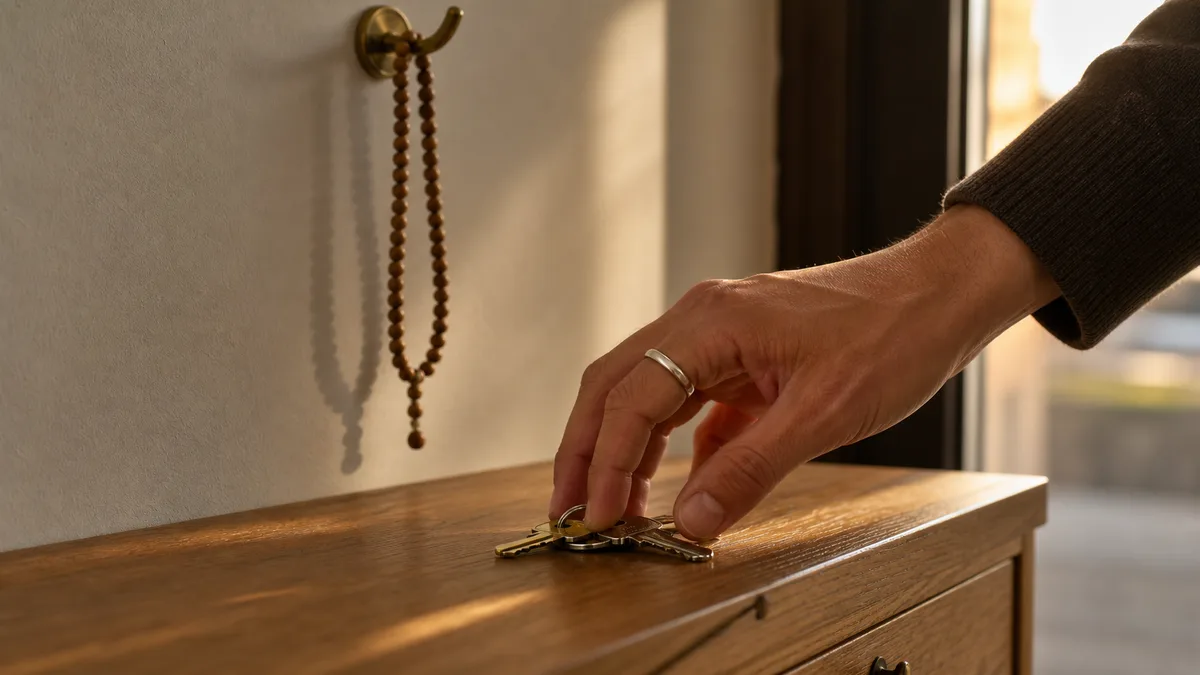
Why build it as jewelry rather than as hardware? Because hardware gets compared, replaced and eventually left in a drawer, while a ring you’d have worn anyway stays on the hand where remembrance actually happens.
Beads get put down. That isn’t a fault, it’s what they’re for: a settled seat, an evening at home, a pace your fingers set. Ring-shaped remembrance answers the other half of the day, the part spent standing, driving and waiting. Form is where dhikr ring meaning stops being abstract.
Form also decides whether a thing can be given. Our Relation series exists for that handover, made to be passed between people rather than only used. Where wearable pieces sit against the purely decorative kinds is mapped at faith jewelry muslim.
Is a Dhikr Ring Meaningful or Just Another Smart Ring, and Is It Halal?
Meaning depends on what you bring to it. A dhikr ring doesn’t do the remembering for you, and it doesn’t turn remembrance into one more thing to finish; what it changes is how easily the practice fits inside a day. Whether counting on a ring is permitted is a separate question, and one worth answering properly.
Is it just another smart ring with a religious label? Fair question, and the honest answer is that it can be, in the same way beads can sit unused in a drawer for years. The difference isn’t in the object, it’s in why you reached for it, and a ring’s whole job is to keep that reason within arm’s length.
Our Peace 1 leans into that quiet. Nothing on it announces itself, so nobody across a desk asks you to explain what you’re wearing.
As for permissibility, we don’t issue rulings on this page. The scholarly positions, including how they handle the electronic forms, are set out at are zikr rings halal, and anything specific to your own situation belongs with a scholar you trust.
Frequently Asked Questions
Does the ring itself carry any spiritual meaning?
No object does that work on its own, and we wouldn’t claim otherwise. The Dhikr entry on Wikipedia defines the word as “remembrance, reminder, mention,”² and all three of those happen inside a person rather than inside a ring. What a ring adds is proximity, which is a smaller and more honest promise.
Is a dhikr ring a meaningful gift, or does it read as giving technology?
It reads as jewelry to most people who unwrap it, in our experience. As of July 2026 our iTasbih line runs to five series, and the ones most often chosen for giving, Relation and Salam among them, arrive boxed and named rather than listed by specification. See above for what wearing one signals.
My family says tasbih ring. Does the name change what it is?
Not at all. Wikipedia’s Misbaha entry describes the bead string your family means by tasbih⁵, and the ring simply took that job over. Dhikr and zikr are one Arabic word in two English spellings, as the naming table above sets out across all five labels. The object on the finger is identical in every case.
Do I have to stop using my prayer beads?
Nothing about wearing one retires a misbaha. Britannica’s subhah entry records bead strings running to 100, 33 or 25⁶, and plenty of readers keep theirs for settled, seated dhikr while the ring covers the moving parts of a day. Two habits, two moments, no conflict between them.
Reviewed by the WESLAMIC Editorial team. This page explains what a term means and describes a practice for general understanding; it does not issue a fatwa. For guidance on your own situation, please consult a qualified scholar you trust.
Sources
⁶ Encyclopaedia Britannica, “Subhah” (Muslim prayer beads), retrieved 2026-07-30
WESLAMIC, iTasbih product data (Shopify products.json, zikr-ring collection, brand first-hand), retrieved 2026-07-30