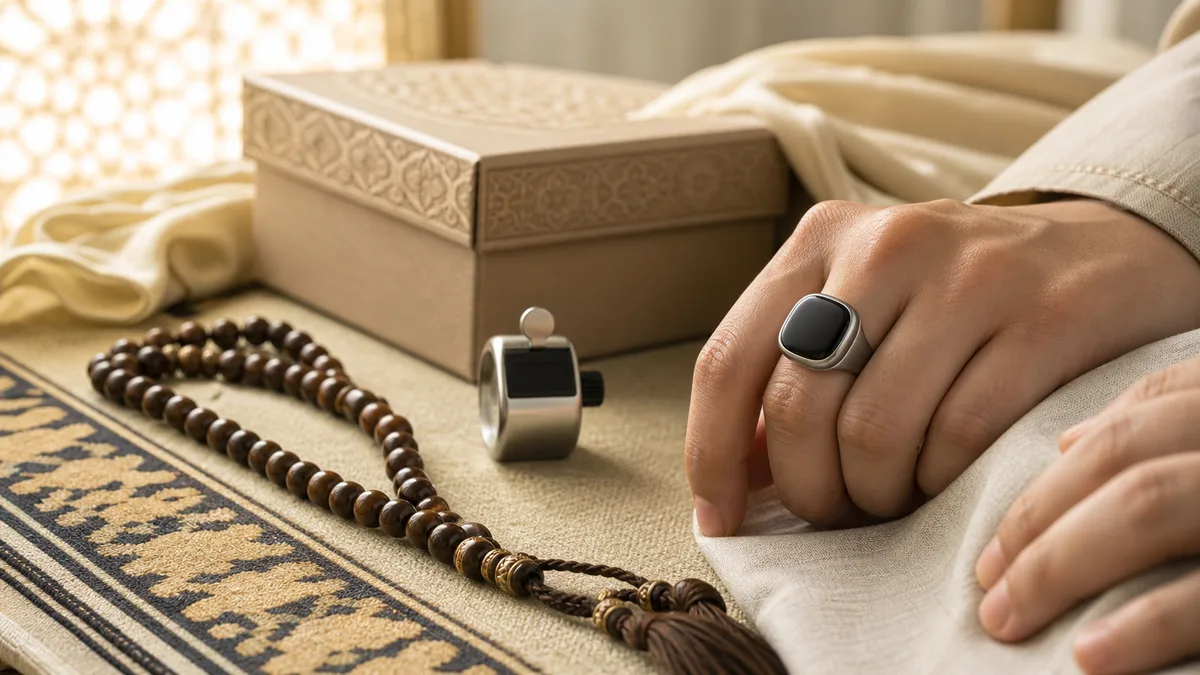
You sit down to make dhikr. Then the day crowds in and you lose your place. Was that thirty, or thirty-one? And just like that, you’re out of the moment.
A dhikr counter is built for that gap. It holds the number quietly, a small companion, so your heart can stay with the words. Heading into 2027, as screens pull harder at our attention, that kind of low-friction closeness is worth more than ever.
Key Takeaways
Today’s smart ring descends from the misbaha (prayer beads): the same habit of remembrance, now made wearable.
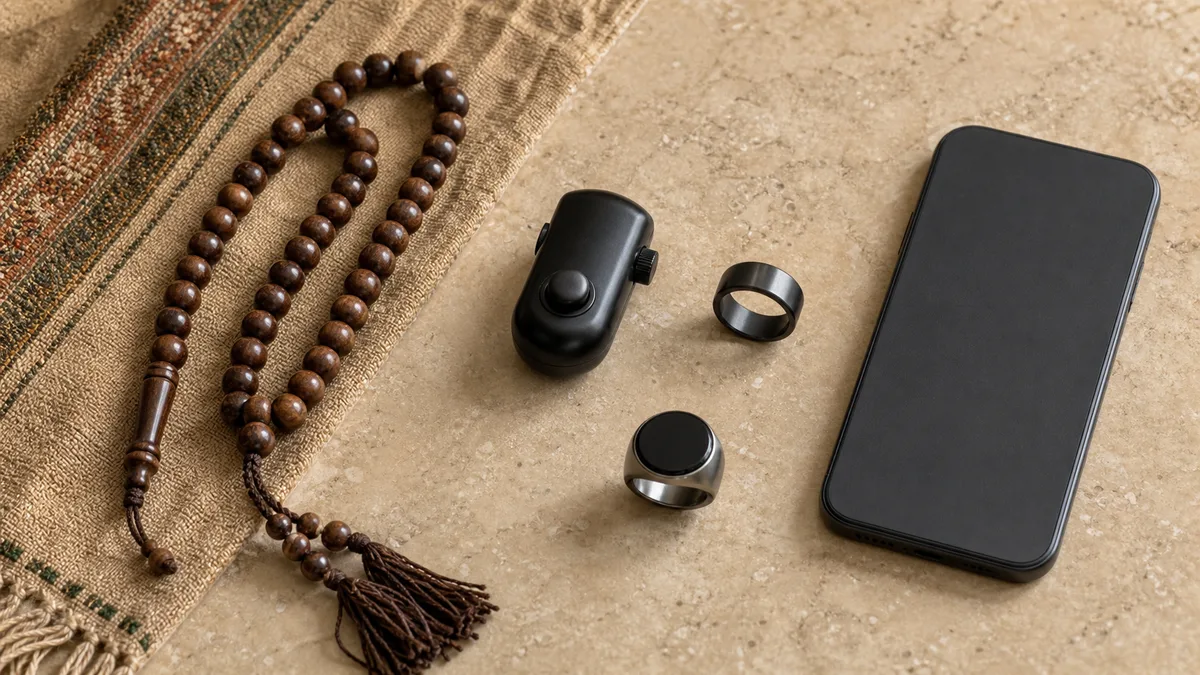
Five modern forms: thumb clicker, finger ring, digital misbaha, smart ring, and phone app.
On most smart rings counting is manual: one press per recitation, with a gentle buzz at each milestone.
Sahih al-Bukhari records 33 SubhanAllah, 33 Alhamdulillah, and 33 Allahu Akbar after each prayer¹; Sahih Muslim completes the hundred with La ilaha illallah².
What Is a Dhikr Counter?
A dhikr counter is a simple way to keep count of your remembrance of Allah, so your focus stays on the words rather than the number. Classical Arabic lexicography glosses dhikr as the remembrance and mention of Allah, and worshippers have long counted it on the fingers or with prayer beads, commonly in sets of 33, 99, or 100.
People reach for one for a plain reason: to never lose their place. When your hands and heart are busy remembering, tracking a number pulls you out of the moment. It holds the number so you don’t have to.
The idea grew from the misbaha, the traditional string of prayer beads Muslims have counted on for centuries. Sahih al-Bukhari records the Prophet teaching his followers to say SubhanAllah, Alhamdulillah, and Allahu Akbar thirty-three times each after every prayer¹; Sahih Muslim adds that the hundredth is completed with La ilaha illallah². Beads made that easy to keep. The 99-bead form even mirrors the ninety-nine names of Allah.
The modern form simply carries the same habit in new shapes, from clickers and finger rings to a digital misbaha, smart rings, and phone apps. Here’s the quiet truth underneath all of them: the number was never the point.
Egypt’s Dar al-Ifta notes that counting aids like the subha keep a worshipper safe from miscounting and free to concentrate³. Counting is only the means. Being present, fully with the words, is the purpose. If you’re weighing whether a ring like this sits right with tradition, see are zikr rings halal.
Types of Dhikr Counters: Clickers, Rings, Misbaha & Apps
There are five main types of dhikr counter: the handheld thumb clicker, the finger tally ring, the digital misbaha, the smart dhikr ring, and the phone app. Each one trades cost, discretion, durability, and features differently, from the cheapest clicker to a ring you’d wear all day.
Think of them as a spectrum. At one end sits the mechanical clicker, all function and no frills. At the other sits the smart ring, which counts, buzzes at milestones, and reads as faith jewelry rather than hardware. Here’s how the five compare on what matters day to day:
Type | Discretion | Feedback | Needs a phone? | Price band | Giftability |
|---|---|---|---|---|---|
Thumb clicker | Low, visible clicking | Mechanical click | No | $ | Low |
Finger tally ring | High, looks like a ring | Bead or notch click | No | $ | Low to medium |
Digital misbaha | Medium | LCD screen, soft beep | No | $ to $$ | Low to medium |
Smart dhikr ring | High, reads as jewelry | Vibration, screen, app | Optional, works offline | $$ to $$$ | High |
Phone app | Low, looks like texting | Screen, haptic tap | Yes, it is the phone | Free to $ | Low |
The clicker and the digital misbaha are the budget entry points: cheap, sturdy, and honest about what they do. A finger tally ring, turned with the thumb, is the most discreet of the simple options, small enough that nobody notices you counting. Some men ask whether wearing any ring is even appropriate first, and that gentle answer sits at can men wear rings in Islam.
The phone app is free and always in your pocket, but it pulls you onto a screen, which is exactly where focus goes to fade. The smart ring is the priciest, yet it folds counting, milestone buzzes, and prayer-time reminders into something you simply wear, like WESLAMIC’s iTasbih line. So which one fits you? That depends on how you actually worship, and we’ll get to that below.
How a Digital Dhikr Counter Actually Counts
On most digital counters and smart rings, counting is manual, not automatic: each short button press adds one. A gentle buzz marks the milestones, usually 33, 66, 99, and 100, so you never have to look at a screen. To start fresh, long-press for about three seconds, which resets the count and saves your last session.
Guessing would ruin the count. A ring that fired on every stray finger movement would double-count when you scratched your nose and miss when you held still. The deliberate press is the feature, not a shortcoming. One press, one dhikr, every time.
The milestone buzz is the quietly clever part. On most rings a gentle pulse marks each set, so your eyes can stay closed and your attention can stay on the words. It’s a soft nudge, never an alarm.
Ending a round is deliberate too, so you never clear the count by accident. For the full press-and-reset walkthrough, see how to use zikr ring.
In our own use across the iTasbih line, the most common question from someone new isn’t about speed or battery. It’s “does it count by itself?” It doesn’t. Once that clicks, the worry falls away and the counting fades into the background where it belongs.
One honest caveat: not every ring buzzes. Our iTasbih-FIT, for instance, carries no vibration motor, so its cues arrive on screen instead. We’d rather say that plainly than let anyone assume every ring does everything. Whether that count survives without your phone nearby is the next question, and the answer surprises people.
Does It Work Offline? Wudu, the Masjid & App Sync
Yes, a smart tasbih ring counts fully offline: the on-ring tally, milestone buzzes, and prayer-time clock all work without a phone. Our iTasbih rings carry an IP67 rating, so they survive wudu and daily splashes. The catch: your count reaches the app only after you reset the ring, and a dead battery wipes the tally.
This is the question worshippers actually care about, and generic buyer guides skip it. Away from your phone, during wudu, in the masjid, nothing stops.
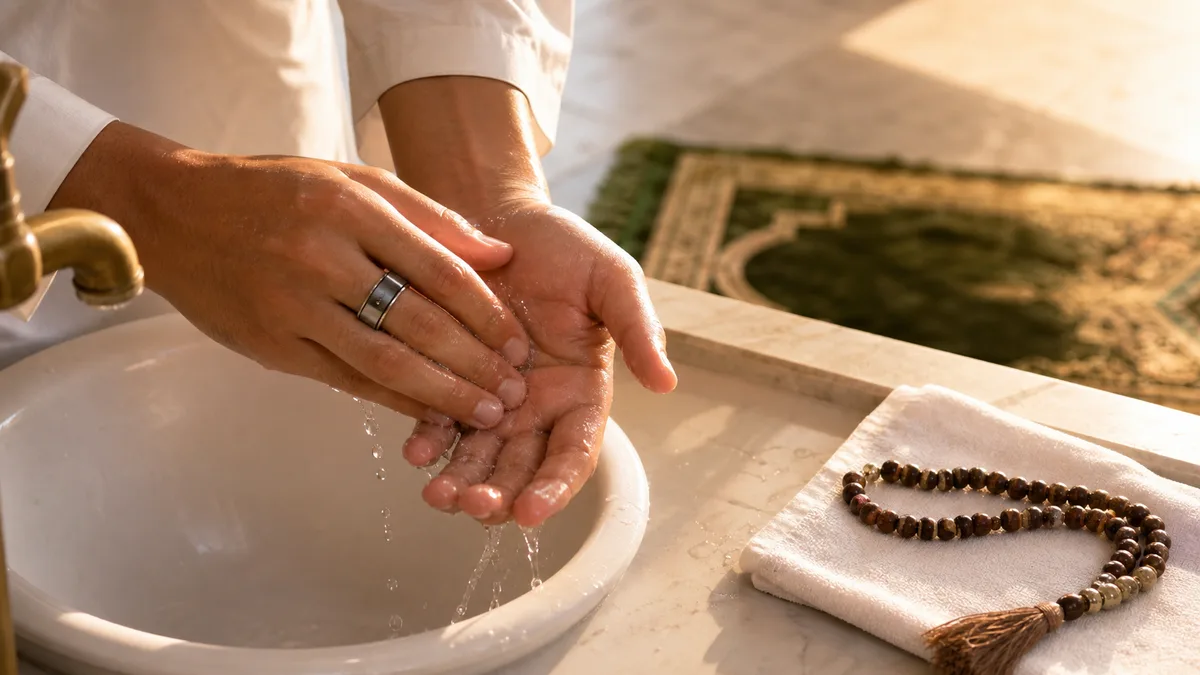
Water is fine too. You needn’t pull the ring off five times a day. Our iTasbih-Peace1, a full-ring design made for around-the-clock wear, is built for exactly that kind of uninterrupted use.
Now the part no flat list tells you. On-ring counting is fully independent, but your app history is not. The tally uploads to the companion app only after you reset the ring to zero, so if you never reset, the app never sees it. And because the live count lives on the ring, a fully drained battery resets it, and the current session is lost. Reset on purpose, and your history stays safe. That single quirk explains most of the confused reviews you’ll read, and knowing it upfront changes how you use the ring.
From Handheld Tally to Smart Ring: The Counter’s Evolution
The dhikr counter has evolved through clear stages, each easing a friction the last one left. In the early Muslim era, remembrance was counted on the fingers and with pebbles. Bead-strings came later; the jurist al-Suyuti (d. 1505) devoted a short treatise, al-Minhah fi’s-Subhah, to defending them, a sign the debate ran into the 15th century.
From there the line is easy to trace. Beads freed the fingers but had to be carried, and they could still lose their place when you were interrupted. The mechanical clicker and the early digital misbaha made the tally harder to lose, yet they were one more thing to pocket and looked the part of hardware.
The finger ring shrank the counter onto your hand. The smart ring is the current form: it counts, remembers your prayer times, keeps your progress in an app, and disappears into everyday wear.
Each leap solved the friction before it. Carry it? Wear it instead. Lost count? Milestone buzz. No reminder? Prayer-time cues. Not beautiful? Make it jewelry. Read as a category rather than a shelf of products, the dhikr counter isn’t a flat list at all. It’s a single form maturing, and the ring is simply where it has arrived.
That arc is the story of our own iTasbih family. The earliest smart counters looked like hardware you’d want to hide. WESLAMIC reworked the ring into faith jewelry with gift-ready design, then pushed further with the iTasbih-Peace1, a full-ring shape made for 24-hour wear, and the iTasbih-FIT, which ties remembrance to healthy daily habits. Heading into 2027, the smart ring has become its most wearable, most everyday form yet.
How to Choose the Best Dhikr Counter
There’s no single best dhikr counter, only the one that fits your day. In our experience, seven checks decide it: feedback you can feel, offline counting, prayer-time reminders, battery and charging, water resistance, app tracking, and everyday comfort. Beginners do well with a clicker or app; daily worshippers wanting one discreet ring lean toward a smart ring.
Run any option past these seven checks:
Feedback you can feel. A buzz or a firm click means you needn’t look, which protects focus.
Offline counting. It should count without a phone, during wudu and in the masjid.
Prayer-time reminders. Gentle cues for the five daily prayers turn a counter into a companion.
Battery and charging. Look for simple magnetic charging and honest battery claims.
Water resistance. An IP67 rating means wudu won’t bother it.
App tracking. A companion app that saves your progress helps the habit stick.
Everyday comfort. If it’s comfortable and good-looking, you’ll actually keep it on.
Now match that to how you worship. If you’re just starting, a plain clicker or a free app is a fine, low-stakes beginning.
Our iTasbih-Salam is the gentlest ring to start with, an affordable, thoughtful first Smart Tasbih that’s just as easy to give as a Ramadan or Eid gift. If you want one ring for almost anyone, our iTasbih-Faith is the safe classic: five interchangeable sizes, gentle app-connected prayer reminders, and a look that fits nearly every hand.
Traveling often? Favor longer battery life and a charging case. Buying a gift? Lean toward something giftable enough to feel special. New to the whole category and want to see the range in one place? See all smart tasbih ring.
Getting Started: Pairing Your Smart Dhikr Counter
Setting up a smart tasbih ring takes four steps: charge it fully, download the brand’s companion app, power it on with a long press, then pair over Bluetooth or NFC. Each ring binds to one account. Once bound, the home screen becomes a clock, and a short press starts counting.
None of this is complicated. Charge the ring fully first, since a flat battery mid-setup is the usual snag. Then download the companion app for your ring. Different makers use different apps, so use the one your ring calls for, such as the WESLAMIC app for an iTasbih. Power on with a long press, and pair over Bluetooth.
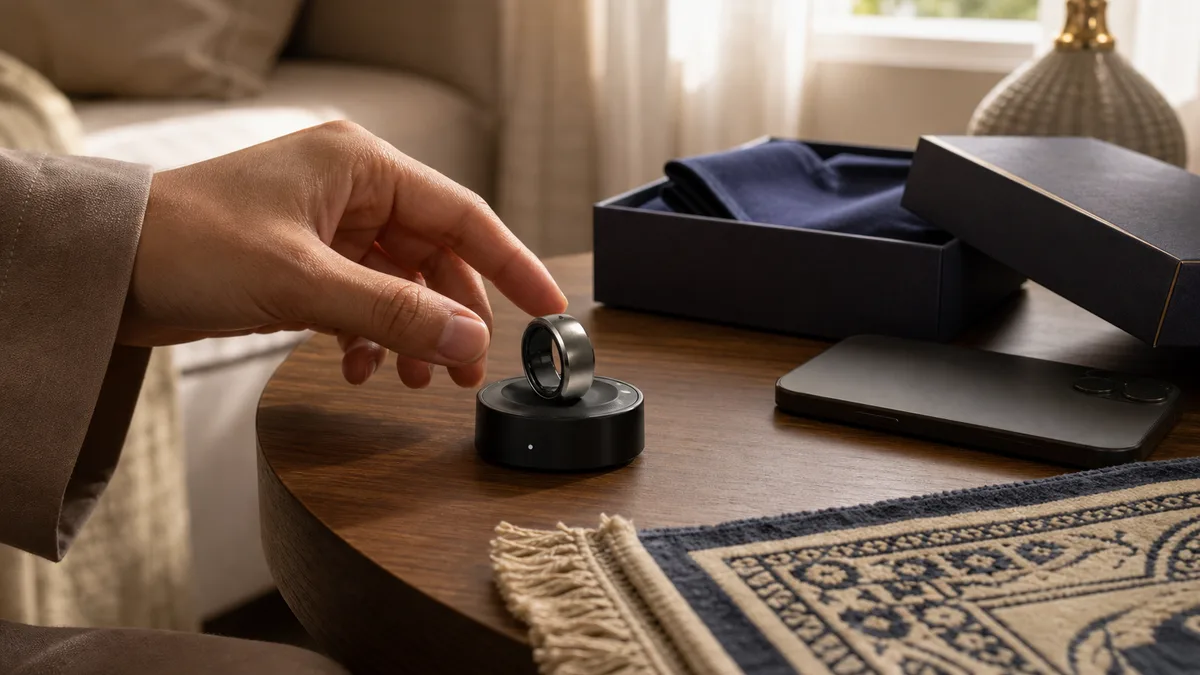
Some rings also pair or share by NFC. Our iTasbih-Relation, for instance, carries an NFC card you can tap to share your details, no app needed. It’s a small touch that makes a premium gift feel considered.
A couple of things to expect. Each ring binds to one account, so decide whose it is before you bind it, especially if it’s a gift. After binding, the home screen usually switches to a clock, and you short-press to enter counting. The sync quirk we covered above still applies here, so give it a second read before you lean on the app history. Set it up once, and the ring quietly keeps company with your day.
Dhikr Counter FAQ
Is a dhikr counter the same as a tasbih counter? Yes. A dhikr counter, tasbih counter, tasbih counter, prayer counter, and digital tasbih all name the same family of aids: they keep count of remembrance. The words dhikr and zikr mean the same act, so the labels are interchangeable. In practice you’ll meet at least five forms of it, from beads to smart rings.
Is a digital dhikr counter halal, or is it bid’ah? Most scholars treat a counting aid as permissible. Muslims have counted dhikr on the fingers and with pebbles since the early Muslim era, long before beads, so a modern counter is the same habit in a new shape. It’s a matter for qualified scholars, not us, so ask one you trust and see our note above.
Can I use a dhikr counter during salah? During the formal prayer itself, many scholars suggest counting on the fingers and keeping the ring for the dhikr that follows. For remembrance around the five daily prayers, a counter shines: it tracks your sets so your attention stays on the words. Views differ here, so ask a scholar you trust for your case.
How long does a dhikr counter’s battery last? Most everyday smart rings run up to about a week on one charge. Pair one with a charging case, as our iTasbih-Relation does with a case rated for around a month of use, and you’ll top up far less often. Simple designs like a bead clicker use no battery at all, and charging is usually a quick magnetic snap.
Sources
Edward W. Lane, An Arabic-English Lexicon (London: Williams & Norgate, 1863-1893), root dh-k-r, glossing dhikr as remembrance and mention, including the remembrance of Allah.
Encyclopaedia of Islam, 2nd ed., “Subha” (the misbaha bead lineage and the juristic debate over prayer beads that ran into the 15th century, including al-Suyuti’s treatise al-Minhah fi’s-Subhah defending their use).
¹ Sahih al-Bukhari 843, Sunnah.com, retrieved 2026-07-01 (the Prophet teaching SubhanAllah, Alhamdulillah, and Allahu Akbar thirty-three times each after every prayer).
² Sahih Muslim 597, Sunnah.com, retrieved 2026-07-01 (the same thirty-three-each remembrance totaling ninety-nine, then completed to one hundred with La ilaha illa Allah wahdahu la sharika lah).
³ Egypt’s Dar al-Ifta, Ruling on using the subha (prayer beads), fatwa 7783, retrieved 2026-07-01 (the subha keeps a worshipper safe from miscounting and helps concentration).
WESLAMIC first-party product specifications and first-hand product use, 2026 (counting mechanism, milestone and prayer cues, offline and sync behavior, IP67 rating, model differences including iTasbih-FIT, and battery and pairing details).
This guide is general information from the WESLAMIC Editorial team (see our editorial standards and contact). It doesn’t issue a fatwa. For rulings specific to your situation, please consult a qualified scholar you trust. Every dhikr matters, and we’re here to keep you company on the way closer.